


LegalOn vs. GC AI: Which Legal AI Platform Fits Your Workflow?
.jpeg)


LegalOn and GC AI are both AI platforms for in-house legal teams, but they emphasize different parts of the legal workday.
LegalOn combines contract review and redlining with attorney-built and custom Playbooks, Matter Management, intake, Vault contract intelligence, and broader legal-assistance workflows. GC AI combines legal research, drafting, contract review, Projects, contract intelligence, and general legal assistance in one workspace.
This guide compares how LegalOn and GC AI approach contract review, legal research, matter context, contract intelligence, security, and pricing. Both platforms now extend well beyond their earlier contract-review and research use cases.
Key Takeaways
- LegalOn combines contract review with a large attorney-built Playbook library, Matter Management, intake, Vault, and broader in-house legal workflows.
- GC AI combines legal research, drafting, contract review, Projects, Playbooks, and Contract Intelligence in one legal AI workspace.
- LegalOn’s full platform library contains more than 135 attorney-built Playbooks, available from the Core Review package upward. GC AI provides four pre-built Playbooks and lets teams create custom Playbooks from their own standards and precedents.
- GC AI provides dedicated legal research across more than 13 million U.S. federal and state court opinions, statutes, regulations, agency guidance, and other authoritative sources.
- LegalOn currently uses customized pricing based on team size and capabilities and offers a 14-day free trial with onboarding included. GC AI currently publishes an Individual plan price and also offers a 14-day trial.
[cta-1]
What Is LegalOn?
LegalOn is an AI platform for in-house legal teams covering contract review, drafting, legal assistance, Matter Management, intake, and post-signature contract intelligence.
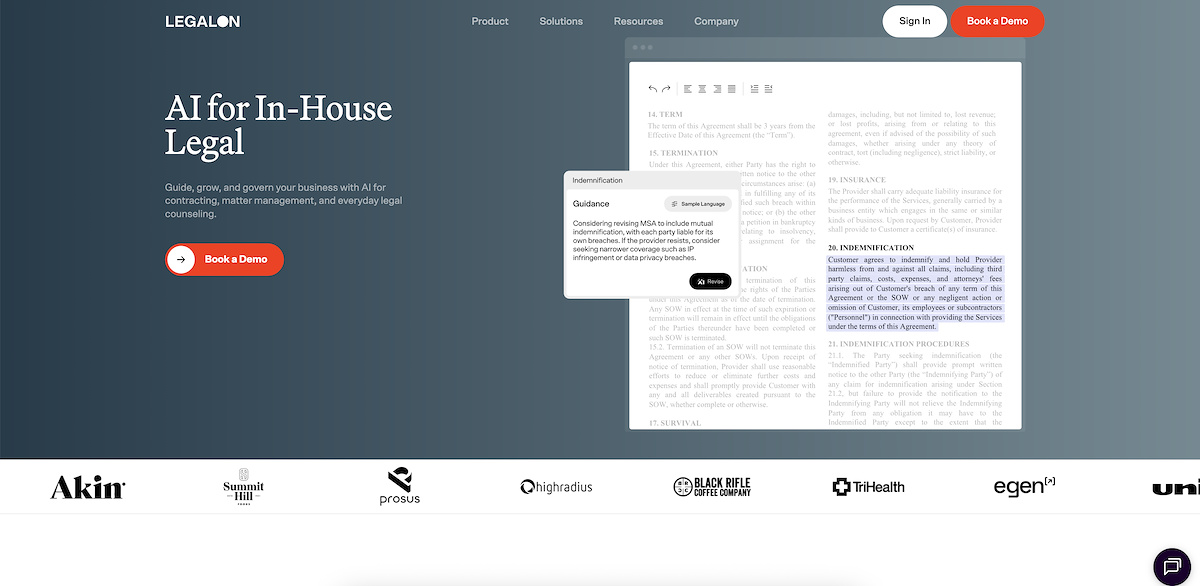
The platform extends from first-pass contract review through matter management and post-signature contract intelligence. It works inside Microsoft Word for drafting, review, and redlining.
LegalOn Contract Review
LegalOn reviews agreements against both attorney-built and organization-specific standards.
The platform includes more than 135 attorney-built Playbooks, and the Core Review package carries that pre-built library for common agreements. Teams can create their own positions in plain English or use Playbook Agent to turn templates and precedent into structured review instructions; both currently require the Contracting Suite package rather than Core Review.
LegalOn works directly inside Microsoft Word, where a lawyer can preview proposed changes and apply them as redlines. The attorney-built Playbooks cover common commercial agreement types, so a team reviewing an agreement outside those categories has to build its own positions before the review reflects them.
LegalOn Matter Management and Vault
LegalOn covers legal intake and matter management.
Matter Management centralizes intake, ownership, deadlines, workload, and matter context. Intake can come through email, custom forms, Slack, and Microsoft Teams. Matter Intelligence can also surface information from past matters. Matter Management, the Intake and Triage Agents, and Matter Intelligence currently require LegalOn’s Productivity Suite package; Vault is available one tier below, in the Contracting Suite package.
Vault turns executed agreements into searchable, structured contract data. It can surface information such as obligations, renewal dates, counterparties, and other contract terms across a portfolio or a selected project. Vault reflects the executed documents loaded into it, so a lawyer still has to confirm that the contract set is complete and current before relying on a portfolio view.
LegalOn Legal Assistance and Research-Oriented Workflows
The LegalOn Assistant is the platform’s AI legal assistant for contract work and drafting. It answers questions about a single contract or across a team’s whole repository, and drafts fallback language. The built-in skills generate issue lists, extract key terms, summarize obligations, and look up defined terms. Assistant draws only on the agreements loaded into that repository, so a lawyer still has to confirm the relevant contract is there before relying on an answer.
LegalOn offers more than 100 attorney-built Prompt Workflows spanning areas including:
- commercial contracts
- data privacy
- employment
- compliance
- mergers and acquisitions
- litigation
- intellectual property
- corporate governance
- legal research
- legal operations
What Is GC AI?
GC AI is an AI workspace built for in-house legal teams. It combines legal research, drafting, document analysis, contract review, Projects, Playbooks, Microsoft Word, and contract intelligence.
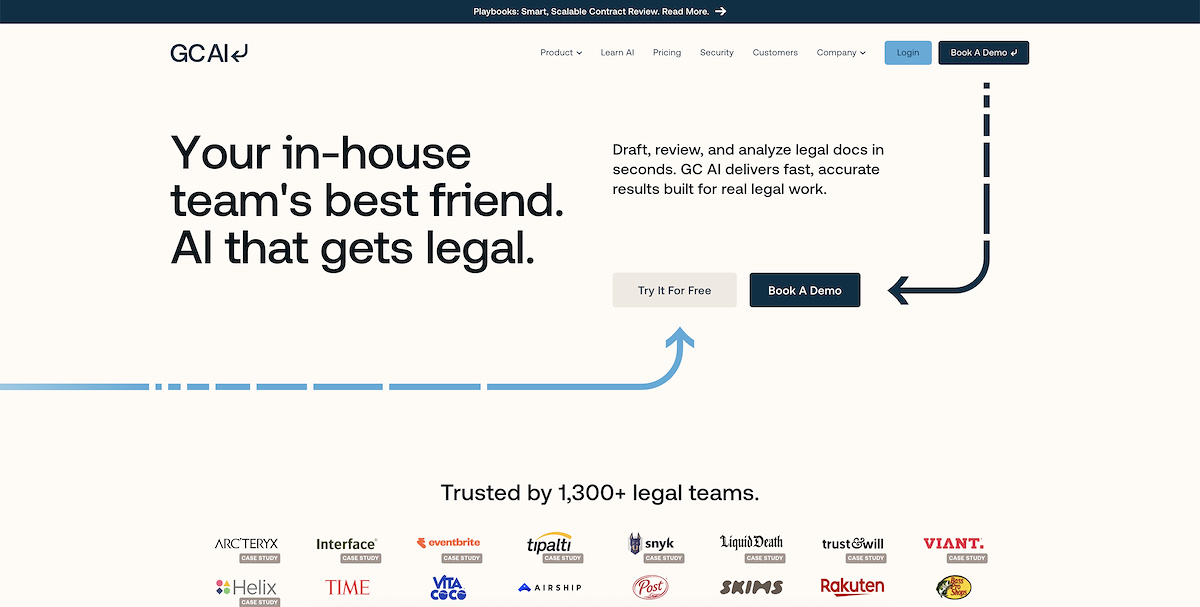
GC AI supports a broad range of in-house legal work. Lawyers can research legal questions, work from uploaded documents and project context, draft language, review contracts against Playbooks, and analyze signed contracts within the same platform.
GC AI Legal Research
GC AI Research uses specialized research agents to search across jurisdictions, agencies, courts, statutes, regulations, and government guidance.
The GC AI case-law database contains more than 13 million U.S. federal and state court opinions. Research outputs include citations and links to supporting sources, and the reviewing lawyer can cross-check findings from multiple research workstreams before presenting the final analysis. Research output still requires a lawyer to verify each citation against the primary source before it is relied on.
GC AI Projects
GC AI Projects groups related chats, files, and instructions into a persistent workspace.
Chats within a Project can share context, and GC AI can reference other conversations and files associated with that Project. Teams can also set project-level instructions and share Projects with colleagues. A Project carries only the files and chats added to it, so work that spans several Projects requires a lawyer to move the relevant context across.
Projects preserve matter context, but they are different from LegalOn’s dedicated Matter Management system, which includes intake, ownership, workload, status, and operational tracking.
GC AI Playbooks
GC AI Playbooks apply defined contract-review standards inside GC AI and Microsoft Word.
GC AI currently provides four pre-built Playbooks: non-disclosure agreements (NDAs), data processing agreements (DPAs), master services agreements (MSAs) for SaaS, and MSAs for commercial purchases. Teams can also create custom Playbooks from templates, previously negotiated agreements, and other uploaded materials. Agreement types outside those four categories need a custom Playbook before GC AI can review them against a defined standard.
GC AI Contract Intelligence
GC AI also extends into post-signature contract analysis.
Contract Intelligence can connect to contract repositories, extract terms into structured views, link amendments and related documents into contract families, and show the terms currently in force. Extracted information includes citations back to the underlying source language. Extracted terms are a starting point rather than a conclusion, so a lawyer still has to open the cited clause before acting on one.
Contract Intelligence brings GC AI closer to LegalOn Vault on post-signature contract analysis.
LegalOn vs. GC AI at a Glance
| Dimension | LegalOn | GC AI |
|---|---|---|
| Primary emphasis | In-house contracting, matters, intake, and legal operations | Broad in-house legal AI workspace |
| Contract review | Attorney-built and custom Playbooks, AI redlining | Pre-built and custom Playbooks, Word-based review |
| Ready-made Playbooks | 135+ attorney-built Playbooks | Four pre-built Playbooks |
| Microsoft Word | Review, redlining, drafting, Playbooks, Assistant | Review, redlining, drafting, Playbooks, research context |
| Dedicated primary-law research | Research-oriented Assistant and Prompt Workflows | 13M+ U.S. federal and state opinions plus statutes, regulations, and government sources |
| Matter context | Dedicated Matter Management (Productivity Suite) | Projects |
| Contract intelligence | Vault and Vault Projects | Contract Intelligence |
| Intake and triage | Dedicated Intake and Triage Agents (Productivity Suite) | Broader AI workspace and connected workflows |
| Pricing | Customized by team size and capabilities | Individual plan published; Team on request |
| Trial | 14-day free trial; onboarding included | 14-day trial |
| Security | SOC 2 Type II; ISO 27001 and ISO 27017 | SOC 2 Type II; SOC 3; GDPR compliant |
[cta-2]
What Are the Main Differences Between LegalOn and GC AI?
1. LegalOn Builds More Operational Workflow Around Legal Requests
LegalOn connects contract review to Matter Management, intake, triage, workload tracking, and post-signature contract intelligence.
Those connections give LegalOn an operational layer around incoming requests, ownership, status, workload, and matter history.
GC AI’s Projects preserve files, conversations, and instructions around related work, but the platform is structured more as a broad AI workspace than as a dedicated legal matter-management system.
2. LegalOn Provides a Larger Ready-Made Playbook Library
Both platforms can apply a legal team’s own standards to contract review.
LegalOn adds a large attorney-built library alongside custom Playbooks. That library gives teams ready-made standards across many agreement types alongside their own internal positions.
GC AI provides four pre-built Playbooks and places greater emphasis on turning the organization’s own templates, precedent, and negotiated agreements into reusable standards.
3. GC AI Has a More Explicit Primary-Law Research Layer
GC AI searches a dedicated primary-law database, while LegalOn’s research-oriented work runs through the LegalOn Assistant and attorney-built Prompt Workflows against legal content rather than a primary-law database of its own.
4. Both Now Support Post-Signature Contract Intelligence
Both platforms now analyze signed contracts.
LegalOn Vault extracts and organizes information such as obligations, renewals, and key terms across signed contracts. Vault Projects can apply analysis across selected contract populations.
GC AI Contract Intelligence can ingest contract populations, extract terms into structured views, link amendments and related documents, and calculate the terms currently in force across contract families.
LegalOn and GC AI differ in where the contract set comes from. GC AI Contract Intelligence pulls from an existing document store such as Google Drive, SharePoint, OneDrive, or Dropbox, while Vault takes PDFs uploaded directly or connected through DocuSign.
5. Their Security and Hosting Options Differ
LegalOn’s security program currently includes SOC 2 Type II and ISO 27001 and ISO 27017 certifications. LegalOn does not use customer contract data to train its AI models.
LegalOn offers regional data residency, with application servers hosted in Germany, within the European Union, and in Singapore. Customer data in those environments is stored and processed entirely in-region.
GC AI is currently SOC 2 Type II and SOC 3 certified and GDPR compliant. Customer data is encrypted at rest and in transit, is not used to train model-provider AI systems, and GC AI maintains zero-data-retention agreements with its model providers wherever feasible.
How Do LegalOn and GC AI Compare on Pricing?
LegalOn and GC AI use different pricing models. LegalOn uses customized pricing based on team size and selected capabilities. The LegalOn packages include Core Review, Contracting Suite, and Productivity Suite, and LegalOn currently offers a 14-day free trial with onboarding included.
GC AI’s Individual plan is currently $500 per month and can be purchased online without a demo. Team pricing is available on request, and GC AI currently offers a 14-day trial.
| Pricing factor | LegalOn | GC AI |
|---|---|---|
| Standard public price | Not published | Published for Individual |
| Pricing model | Customized by team size and capabilities | Individual published; Team on request |
| Free trial | 14 days; onboarding included | 14 days |
| Single-seat purchase | Quote required | Available online |
| Primary-law research | Research-oriented Assistant and Prompt Workflows | U.S. Case Law add-on for Individual; included with Team |
| Contract intelligence | Vault, from the Contracting Suite package | Not published |
Where Spellbook Fits
Spellbook Review focuses on commercial contract review and negotiation inside Microsoft Word.
It works directly inside Microsoft Word and supports custom Playbooks, suggested redlines and comments, and lawyer approval of proposed changes.
Compare to Market adds a different source of negotiation context by comparing contract terms against market data drawn from more than 20 million contracts, with filters including industry, jurisdiction, and deal type.
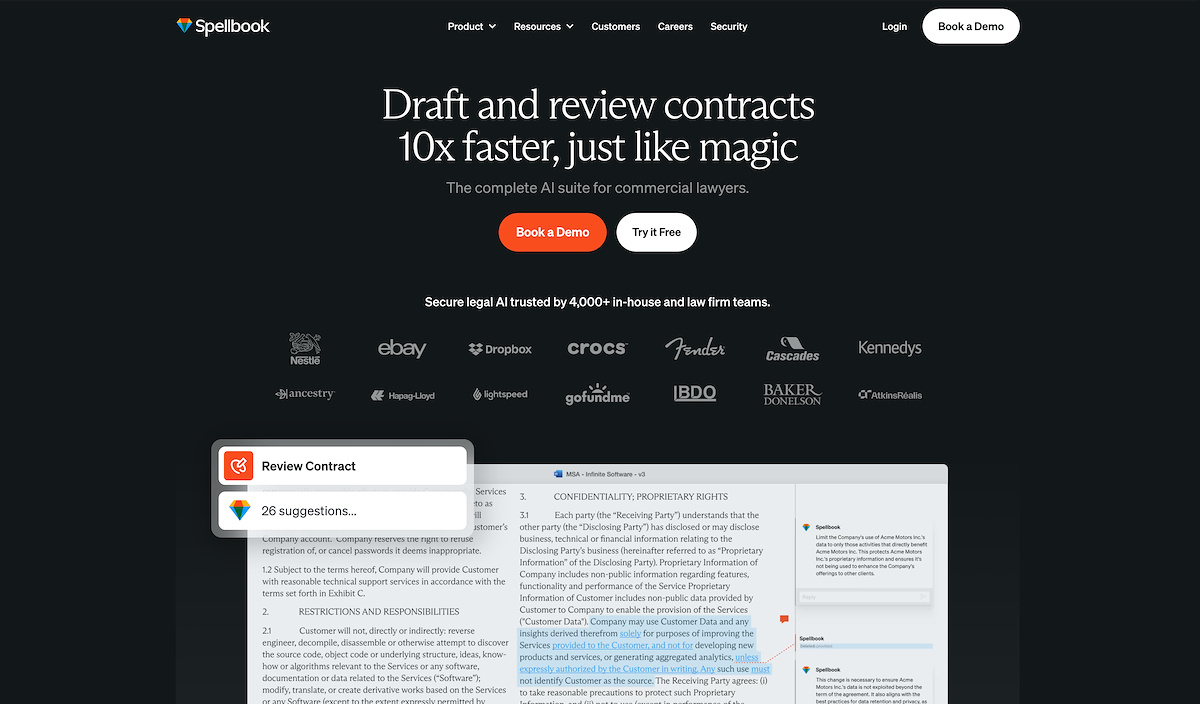
Spellbook also supports multi-document transactional work through Associate and citation-backed legal research through Legal Data Sources, which connects to more than 1,000 public legal databases. Spellbook pricing is custom and structured around the number of team members on a license, with a free seven-day trial.
LegalOn connects contract review with matter management and broader legal operations. GC AI combines broad in-house legal assistance with dedicated primary-law research and contract intelligence. Spellbook focuses more on commercial transactional work, negotiation, Playbooks, and external contract-market data.
LegalOn and GC AI Approach In-House Legal Work Differently
LegalOn and GC AI now overlap across contract review, Microsoft Word, legal assistance, Playbooks, and post-signature contract intelligence.
LegalOn emphasizes matter management, intake, and attorney-built contract standards. GC AI places more emphasis on dedicated primary-law research and a broader AI workspace for in-house legal work.
Frequently Asked Questions
Does LegalOn Support Legal Research?
Yes. LegalOn supports research-oriented work through the LegalOn Assistant and 100+ attorney-built Prompt Workflows, including legal-research workflows. GC AI adds a dedicated primary-law research layer across more than 13 million U.S. federal and state court opinions, statutes, regulations, agency guidance, and other authoritative sources.
Does GC AI Include Matter Management?
GC AI Projects groups files, chats, instructions, and shared context around related work. LegalOn Matter Management adds dedicated intake, ownership, status tracking, workload visibility, triage, and Matter Intelligence.
Can LegalOn or GC AI Replace a CLM?
Both platforms cover parts of the contract lifecycle, but neither replaces a full contract lifecycle management (CLM) system.
LegalOn combines pre-signature review with Vault, Matter Management, intake, and post-signature intelligence. GC AI Contract Intelligence handles signed-contract analysis, repository connections, contract families, and current terms. However, GC AI describes authoring, approval routing, and signature as workflows that can remain in existing systems.
[cta-3]
.png)
.jpg)
.png)
Get buy-in, compare platforms, and make AI stick.



Submission Received
Thank you for your interest!
.svg)
