


Ivo vs CoCounsel: Which Is The Top Pick in 2026?
.jpeg)


The Ivo vs CoCounsel debate requires legal teams to choose between two very different approaches to AI-assisted contract work. Ivo offers a highly structured system for enforcing pre-set negotiation playbooks within Microsoft Word, while CoCounsel provides a broader platform that integrates contract review with the extensive research capabilities of Thomson Reuters. To help you decide, we will break down key factors like product features, pricing, and AI architecture, giving you the information needed to select the right tool for your workflow.
Key Takeaways
- Ivo is a contract review tool that enforces pre-set negotiation playbooks within Microsoft Word, prioritizing consistency. CoCounsel is a broader AI platform from Thomson Reuters that combines contract analysis with its extensive legal research databases.
- The primary distinction in the Ivo vs CoCounsel matchup is their source of truth. Ivo focuses on applying a firm’s internal standards deterministically, while CoCounsel grounds its suggestions in external, authoritative content from Westlaw and Practical Law.
- Spellbook offers a more complete AI suite, trusted by 4,000+ legal teams to draft and review contracts 10x faster and with greater precision. It combines intelligent drafting, customizable playbooks, and a unique Compare to Market feature that benchmarks agreements against real-time data from thousands of similar deals.
[cta-3]
1. Ivo
Ivo is a contract review tool that operates within Microsoft Word, designed to enforce pre-set negotiation playbooks. It is built for legal teams that need to apply their internal standards consistently across high volumes of commercial contracts. Unlike platforms that integrate extensive legal research databases, Ivo is intentionally constrained to executing these user-defined rules. This makes it a tool for enforcing known positions rather than one for broader legal analysis or drafting assistance.

Ivo Features
Ivo’s functionality is centered entirely on enforcing pre-defined standards within Microsoft Word. It is not a general-purpose drafting or research assistant.
- Playbook-Driven Review: Analyzes contracts against custom playbooks to flag deviations from company standards.
- Automated Redlining: Suggests redlines and inline comments based on playbook rules.
- Issue Summaries: Generates reports that categorize issues for internal review.
- Word-Native Workflow: All functions operate directly within Microsoft Word, avoiding the need to switch applications.
Ivo Pricing
Ivo uses a straightforward subscription model with pricing that includes the initial setup of playbooks.
- Annual Subscription: Priced at $6,000 per user, per year.
- Included Services: The fee includes playbook creation by Ivo’s team, onboarding, and support.
- Volume Discounts: Available for teams with 10 or more users.
Key Considerations about Ivo
While Ivo excels at enforcing consistency, its rigid, playbook-centric model presents significant limitations. The platform is designed to execute known positions, not to assist with novel legal questions, research, or strategy. This makes it less suitable for negotiations that require flexibility or data-backed arguments.
A key drawback is that playbooks are built and maintained by Ivo’s internal team, not by users. This creates a dependency that can slow down updates to negotiation positions. The platform also lacks features for data-driven negotiation, such as the ability to compare terms to market standards. For teams weighing Ivo vs CoCounsel, this narrow focus on rule enforcement is a critical factor to consider.
2. CoCounsel
CoCounsel, from Thomson Reuters, is an AI-assisted legal platform that combines contract review tools with its extensive Westlaw and Practical Law databases. It is designed for legal teams that need both internal document analysis—like drafting and redlining—and the option for research-backed answers grounded in authoritative content. Unlike Ivo’s singular focus on enforcing internal playbooks, CoCounsel’s main value proposition is its connection to this vast, proprietary content library, making it a broader but often more complex and costly tool.

CoCounsel Features
CoCounsel’s functionality is split between a Microsoft Word add-in and a separate web portal, combining internal document work with external research capabilities.
- AI-Assisted Workflows: Tools for drafting, summarization, and redlining contracts.
- Playbook Review: Analyzes agreements against internal standards within Microsoft Word.
- Multi-Document Analysis: A web portal for running queries across large document sets.
- Research Integration: Optional access to Westlaw and Practical Law for citation-backed answers.
- Team Collaboration: Shared document repositories and prompt libraries.
CoCounsel Pricing
CoCounsel uses a tiered subscription model, with costs increasing significantly based on access to Thomson Reuters’ legal content databases.
- CoCounsel Core: Starts at $4,500 per user, annually.
- With Practical Law: Increases to $6,600 per user, annually.
- With Westlaw: Rises to $9,000 per user, annually.
- All-In Tier: Costs $10,200 per user, annually.
Key Considerations about CoCounsel
CoCounsel’s greatest strength—its integration with Thomson Reuters’ content—is also its main drawback. The platform’s value is significantly diminished without the expensive Westlaw and Practical Law add-ons, making the base offering less competitive.
The workflow is also fragmented, requiring users to switch between a Word add-in for drafting and a separate web portal for multi-document analysis. This can be inefficient for teams that prefer to work entirely within a single application.
Finally, the complex, multi-tiered pricing structure makes it one of the more expensive options on the market. This high cost can be a major hurdle for teams looking for a straightforward and scalable tool, especially when evaluating Ivo vs CoCounsel on budget alone.
3. Spellbook, The Smarter Alternative
While the Ivo vs CoCounsel discussion highlights different approaches to contract AI, Spellbook offers a more complete suite built specifically for commercial law. It integrates directly into Microsoft Word, where lawyers already work, helping legal teams draft and review contracts 10x faster and with greater precision, without switching applications.
Spellbook is also the only contract AI grounded in real-time market data. Its Review feature analyzes agreements against live benchmarks from thousands of similar deals, providing data-driven answers to "What's market?" in any negotiation. More than 4,000 legal teams, including those at Dropbox, Fender, and Crocs, trust Spellbook to manage contract workflows and reduce legal busywork.
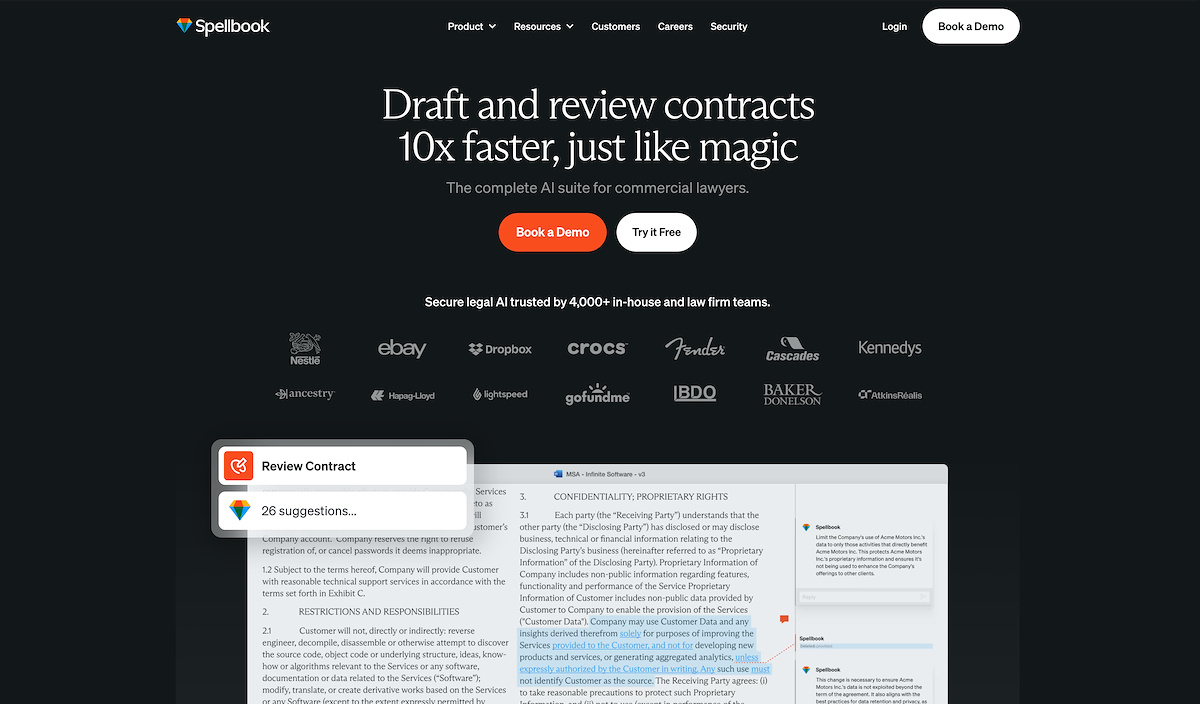
Spellbook Features
- Review: Instantly analyzes entire contracts to identify risks and suggest redlines directly in Microsoft Word. It works with customizable playbooks to enforce your team’s standards, flagging issues and providing AI-generated fixes that appear as track changes under your name.
- Draft: Generates new clauses or entire agreements from simple instructions. This feature can also pull language from your firm’s past contracts or Spellbook’s clause library, automatically adapting the text to match the style and defined terms of your current document.
- Ask: Functions as a contract-specific Q&A tool. You can ask questions about obligations, terms, or other details within the open document and receive answers with citations to the relevant language, helping you quickly verify information.
- Compare to Market: A unique feature that benchmarks your contract’s terms against thousands of similar, anonymized agreements. It provides data-driven answers to "What's market?" for key negotiation points, helping you argue your position with statistical evidence.
- Associate: An AI agent that handles complex, multi-step projects from a single prompt. It can perform tasks like reviewing a data room for due diligence, updating terms across multiple files, or preparing a full document package from a term sheet.
Spellbook Pricing
Spellbook offers custom pricing based on team size and feature requirements.
- Pricing is structured as an annual subscription per user.
- Volume discounts are available for larger teams.
- All core features, onboarding, and support are included.
See how Spellbook works for your team by starting a free trial.
Why Commercial Lawyers Love Spellbook
Unlike tools that focus on either rigid rule enforcement or fragmented research, Spellbook is built to assist with the entire contract lifecycle. While its functionality is centered entirely within Microsoft Word, this design keeps the workflow in one place, eliminating application switching.
Spellbook combines customizable playbooks with unique, data-driven negotiation tools. Its ability to benchmark terms against thousands of real-world agreements gives lawyers a statistical edge that static legal databases cannot match.
This makes it a practical choice for teams that need both consistency and flexibility, a key consideration in the Ivo vs CoCounsel debate.
[cta-1]
CoCounsel vs Ivo vs Spellbook: Key Differences
The choice in the Ivo vs CoCounsel debate often comes down to a core philosophical difference: should contract AI rigidly enforce internal rules, or should it integrate with broad external legal databases? Ivo champions the former, while CoCounsel is built on the latter. Spellbook presents a third, more integrated approach that combines internal standards with real-world data.
1. Ivo: Deterministic Rule Enforcement
- Ivo is designed to execute pre-set negotiation playbooks with high consistency. Its entire workflow is contained within Microsoft Word.
- The platform’s strength is enforcing known company positions. It is not built for flexible drafting, legal research, or data-backed negotiation arguments.
- A key limitation is its rigidity. Playbooks are built and maintained by Ivo’s internal team, creating a dependency that can slow down updates.
2. CoCounsel: Research-Backed Analysis
- CoCounsel’s main value is its integration with Thomson Reuters’ extensive Westlaw and Practical Law databases, grounding its suggestions in authoritative legal content.
- This makes it a powerful tool for research-heavy tasks. However, its workflow is fragmented between a Word add-in and a separate web portal.
- The platform’s effectiveness is heavily tied to expensive content subscriptions, making it one of the costlier options on the market.
3. Spellbook: The Complete, Data-Driven Suite
- Spellbook provides a complete AI suite that operates entirely within Microsoft Word, helping legal teams draft and review contracts with both speed and greater precision.
- It supports customizable playbooks for internal consistency while also offering intelligent AI drafting for greater flexibility.
- Crucially, Spellbook is the only contract AI grounded in real-time market data. Its Compare to Market feature benchmarks terms against thousands of similar agreements, giving lawyers data-driven answers to "What's market?" This provides a practical negotiation advantage not found in the other tools.
Which Option Is Right For Your Business?
For Teams Prioritizing Rigid Playbook Enforcement
If your primary goal is to enforce a strict, pre-approved negotiation playbook across a high volume of standardized contracts, Ivo is the most direct fit. Its entire system is designed for deterministic rule application within Microsoft Word, making it ideal for teams that must maintain strict consistency.
For Teams Needing Deep Legal Research Integration
For law firms or corporate departments whose work is heavily tied to legal research, CoCounsel is the logical choice. Its value comes from its direct integration with Thomson Reuters’ content libraries, making it ideal for tasks that require citation-backed analysis from authoritative sources.
For Most Commercial and Corporate Legal Teams
For teams that need a balance of consistency, flexibility, and data-backed negotiation power, Spellbook is the strongest option. It combines customizable playbooks with intelligent drafting inside Microsoft Word, supporting the entire contract lifecycle. Its ability to provide market data gives lawyers a practical edge in negotiations.
The Bottom Line
Your decision in the Ivo vs CoCounsel matchup depends on your team’s core need. Ivo offers rigid control, and CoCounsel provides research depth. Spellbook delivers a more balanced and practical tool for the day-to-day realities of commercial contract work, combining speed, precision, and data-driven insights in one place.
Try Spellbook Free
Spellbook stands apart by combining the consistency of playbooks with the flexibility of AI drafting and the unique advantage of real-time market data, all within Microsoft Word.
This integrated approach helps your team work with greater speed and precision. Experience the difference for yourself by starting a free trial today.
Frequently Asked Questions
What AI models do Ivo and CoCounsel use, and how is data security handled?
CoCounsel’s AI is integrated with Thomson Reuters’ proprietary content from Westlaw and Practical Law, using this vast database to inform its outputs. Ivo, in contrast, operates more as a deterministic system that executes rules from a pre-defined playbook, rather than relying on a generative AI model for its core analysis.
For any legal technology, data security is a critical point of evaluation. It is important for legal teams to understand how their confidential contract data is handled, whether it is used for training models, and what protections are in place. Understanding whether an AI tool offers a private, secure environment is a necessary step in the procurement process, as general AI privacy concerns are magnified when dealing with client information.
How much customization is possible with Ivo and CoCounsel?
Ivo’s customization is managed by its internal team. When you subscribe, they build your negotiation playbooks for you. While this simplifies initial setup, it also means that any updates or changes to your negotiating positions must be routed through their team, which can introduce delays.
CoCounsel also allows for review against internal standards, suggesting it has a degree of customization. However, the platform’s primary value is its connection to Thomson Reuters’ external content. Teams considering CoCounsel should clarify the extent to which they can build and modify their own playbooks without assistance.
Where does Spellbook fit in the Ivo vs CoCounsel comparison?
Spellbook offers an integrated alternative that combines the strengths of both approaches while addressing their limitations. Like Ivo, it supports playbook-driven reviews for consistency, but these playbooks are fully customizable by your team directly within Microsoft Word. This provides control without creating dependencies on an external team.
Unlike CoCounsel, Spellbook’s entire suite operates within Word, providing a unified workflow for drafting, analysis, and review. Most importantly, Spellbook’s source of truth is not a static legal database but real-time market data. The Compare to Market feature gives lawyers data on how clauses like limitation of liability are being negotiated in thousands of recent deals, offering a practical advantage that is absent in the Ivo vs CoCounsel discussion.
[cta-2]
Our Research Methodology
This comparison is based on comprehensive research of publicly available information, including product websites, feature documentation, press releases, customer reviews, legal technology publications, and third-party analyses from sources like LawSites, Artificial Lawyer, and industry analysts.
Where pricing information is not publicly disclosed, we've included estimates based on available industry data and user reports. Information is current as of 2026 and may change as products evolve. We encourage readers to verify details directly with vendors and request demos to evaluate fit for their specific needs.
.png)
.jpg)
.png)
Get buy-in, compare platforms, and make AI stick.



Submission Received
Thank you for your interest!
.svg)
