
Demo Spellbook, get an Oura Ring 5*
See how Spellbook helps legal teams draft contracts faster than ever before.
Book Demo


AI legal document analysis is the use of a trained language model to read a legal document, extract its clauses, defined terms and dates, compare them against a playbook or market terms, and flag the provisions that fall outside that standard. The analysis covers contracts, non-disclosure agreements (NDAs), service agreements, commercial leases, mergers and acquisitions (M&A) disclosure schedules and compliance records, and it runs in six steps: set the review standard, confirm the tool's data handling, extract the clauses, compare them against the playbook, verify each flagged provision against the source text, and record what the review changed.
The analysis narrows where a lawyer looks, which is what an AI contract review tool is for. It does not decide what a clause means, and the lawyer who signs the redline still owns that judgment.
Key Takeaways
- AI legal document analysis produces three artifacts: a clause inventory, a deviation list and a set of risk flags.
- Standard first: an AI legal document analysis run without a written review standard returns a list of clauses rather than a list of problems.
- Verification: every flagged provision is checked against the source text, as a step in the workflow rather than an optional extra.
- Document type: what the analysis pulls out of a commercial lease is not what it pulls out of an NDA.
[cta-1]
What AI Legal Document Analysis Does
AI legal document analysis does three jobs on a document and produces one artifact from each. Extraction returns a clause inventory: the parties, dates, defined terms, dollar amounts and the clauses themselves, pulled into a structured list. Comparison returns a deviation list, measuring each extracted term against a reference point such as the team's playbook or market data on how the clause is usually drafted. Risk flagging returns the short list a lawyer actually opens, marking the provisions that sit outside the reference point with the reason each one was marked.
Extraction: The Clause Inventory
A clause inventory on a 40-page master services agreement (MSA) carries one row per provision, each with its section number:
- The clause text, quoted in full rather than paraphrased.
- The section number the provision sits at, including schedule and annex references.
- The defined terms the provision depends on, with the section where each one is defined.
- The dates, notice periods and amounts the provision carries.
The inventory is only as useful as its quotations, and legal AI tools differ in whether each row carries the quoted clause text or only a paraphrase of it. A paraphrase cannot be checked against the document, which makes the two jobs that follow unverifiable as well.
Comparison: The Deviation List
A deviation list is that inventory measured against a reference point. Where the playbook carries a preferred position and a fallback that is still acceptable, the list states which of the two each clause meets, and the clauses that meet neither go into the negotiation. A deviation list built against market data answers a different question: not whether the clause meets the team's standard, but whether the counterparty's position is unusual for this document type.
Risk Flagging: The Short List
A risk flag without its reason attached gets re-read from scratch, because the lawyer opening the file has to reconstruct why the provision was marked before deciding whether it matters. A usable flag carries three things:
- The provision, quoted, with its section reference.
- The standard it missed, named as the playbook position or the market position.
- The consequence that follows if the provision stays as drafted.
That is enough for a senior lawyer to triage the list in one pass. A flag names the problem, not the fix: proposing the replacement wording is the job of an AI legal writing tool rather than of the pass that raised the flag.
Types of Legal Documents Analyzed by AI
The types of legal documents analyzed by AI are the ones with a recognizable structure: commercial contracts, NDAs, service agreements, commercial leases, M&A disclosure schedules, corporate governance records and compliance reports. Document type determines what the analysis should pull out, and these documents split into extraction problems and comparison problems. A commercial lease is an extraction problem, because the escalation mechanics and the operating expense definitions turn on finding the right clause, while an NDA is a comparison problem against a short set of standard positions.
| Document type | Extract first |
|---|---|
| Commercial contract | Term, termination, indemnity, limitation of liability, assignment |
| NDA | Definition of confidential information, carve-outs, term, residuals, return-or-destroy |
| Service agreement | Scope, service levels, remedies, change control, acceptance |
| Commercial lease | Rent escalation mechanics, operating expense definitions, renewal and holdover, assignment and subletting |
| M&A disclosure schedule | Schedule-to-representation mapping, closing conditions, survival periods |
| Corporate governance record | Authorizations, quorum, signing authority, consent requirements |
| Compliance report | Regulatory references, dates, obligations, owners |
Extraction Problems and Comparison Problems
Which pass carries the work turns on the split:
- An extraction problem turns on finding provisions that are hard to locate, such as an operating expense definition buried in a lease annex.
- A comparison problem turns on measuring provisions against a short standard.
- A document can be both, and an MSA with a long schedule set usually is.
Analysis and generation are adjacent jobs rather than the same job, because legal document automation produces a document from the team's own template, while analysis reads a document the counterparty drafted and whose structure nobody controls.
How to Analyze a Legal Document With AI, Step by Step
Analyzing a legal document with AI takes six steps: set the review standard, confirm the tool's data handling, extract the clauses and obligations, compare them against the playbook, verify each flagged provision against the source text, and record what the review changed. The order determines the result, because an extraction pass run before a standard is set returns a list of clauses rather than a list of problems.
1. Set the Review Standard Before You Upload Anything
The standard is the list of positions the document will be measured against. A standard that exists only in a senior lawyer's head produces a clause list rather than a problem list, because nothing in the extraction tells the tool which clauses are wrong. Writing the positions down is also what makes two reviewers on the same team agree, and a contract review checklist is the minimum workable version of the standard for a team with no playbook yet. Some of those positions are not legal positions at all: scope, service levels and data terms are usually owned by product, revenue or procurement, and the written standard has to carry their answer too.
- Preferred position: the clause as the team would draft it.
- Fallback position: the version that is still acceptable without an escalation.
- Walk-away position: the term the team will not sign, and who has to approve an exception.
2. Confirm How the Tool Handles the Document
The duty attaches before the upload, not after the output comes back. Confidentiality under ABA Model Rule 1.6 covers all information relating to a representation, and sending a client document to a third party that may retain it engages that duty whatever the tool returns. ABA Formal Opinion 512 addresses generative AI against the same rule.
The State Bar of California's practical guidance on generative AI states that generative AI products often use the information a user inputs, including prompts and uploaded documents, to further train or refine the AI, and might also share that information with third parties. The same guidance ties the diligence a lawyer owes to the level of system access and autonomy the tool has, so an agentic tool reaching into a document management system carries a heavier burden than a single-document summarizer. D.C. Bar Ethics Opinion 388 reaches the same place from a second jurisdiction, working through the confidentiality analysis a lawyer runs before putting client information into a generative AI tool.
- Training: whether the vendor uses inputs to train or refine the model.
- Retention: how long the document and the prompt are stored, and whether deletion on request is available.
- Access: which vendor personnel and subprocessors can see the document.
3. Run the Extraction Pass
The first pass asks the tool what the document says, not what is wrong with it. Run extraction across the whole document including schedules and exhibits, because the definition that breaks a clause usually sits in a schedule: a limitation of liability that looks ordinary in the body can be undone by an exclusion carved into an annex. Ask for the section reference on every row, because a row without one cannot be checked at the verification step.
- Every defined term, with the section where it is defined.
- Every date, notice period and renewal trigger.
- Every obligation, with the party that owes it.
4. Compare the Extracted Terms Against the Playbook
Comparison turns the inventory into a deviation list, and the reference point determines what the list means. Measured against a contract playbook, a clause either meets the preferred position, sits on the fallback, or falls outside the standard. Measured against market data the same clause is either ordinary or unusual for its document type, which is the question worth asking when a counterparty refuses to move on a term the playbook treats as negotiable.
- Compliant: the clause meets the preferred position.
- Fallback: the clause meets the acceptable version and needs no escalation.
- Outside the standard: the clause needs a redline, an approval, or both.
5. Verify Every Flagged Provision Against the Source Text
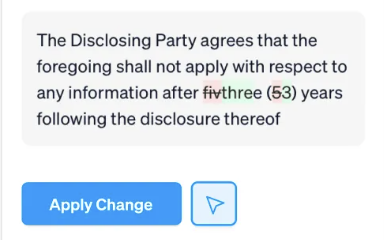
Verification is a three-part check on each flag. The third part is where corrections concentrate, because a model can quote a clause accurately and still describe an effect the clause does not have.
- The quotation: the words the output attributes to the clause appear in the document.
- The reference: the section cited is the section those words come from.
- The consequence: the effect described follows from the clause as drafted, read together with its defined terms.
The published evidence for making verification a step rather than a preference comes from legal research tools rather than contract tools. Stanford HAI's benchmarking of legal models found hallucinated output in at least one in six queries, and an earlier RegLab study found general-purpose chatbots hallucinated on 58% to 82% of legal queries. Neither figure is a contract-analysis error rate, and quoting one as though it were is its own accuracy problem. The scope cuts the other way as well, because AI legal research asks a model to find authority that may not exist, while contract analysis asks it to read a document already in front of it.
Tools differ in how verifiable their output is, and one that returns a conclusion with no quotation and no section number cannot be checked at this step at all, which is why a comparison between AI legal document review tools starts with whether each one cites what it read.
6. Record What the Review Changed
The record is the part that survives the matter: what was extracted, what was flagged, what was verified, what was changed, and who approved each change. On the competence question, D.C. Bar Ethics Opinion 388 states that technology has not altered lawyers' fundamental ethical obligations, and that competence includes understanding enough about any technology the lawyer uses to be reasonably confident that the technology will advance the client's interests. That is a standard a team meets with a record of what it checked, rather than with an assurance about the tool.
- The standard the document was measured against, and which version of it.
- The flags raised, and the disposition of each one.
- The provisions changed, with the approver named.
How to Prompt AI for Legal Document Analysis
A prompt for legal document analysis has to name three things: the standard the clauses are measured against, the output format, and the section reference the tool must quote. A prompt that asks the tool to review this contract returns a summary; a prompt that names the clause set, the position each clause has to meet and the section reference the tool must quote returns something a lawyer can act on. The four instructions below cover the passes a commercial lawyer runs most often.
1. Clause Inventory With Citations
The first pass is the inventory, and the instruction has to say what to do when a clause is absent, because a silent omission is the failure mode that costs the most. The same discipline runs through the contract review prompts a team keeps on file: name the clause set, demand the section reference, and require an explicit statement where a clause is not there.
You are reviewing a [document type] for [party role]. Governing law is [jurisdiction].
Return a table with one row per clause in this set: term and renewal, termination for convenience, termination for cause, indemnity, limitation of liability, insurance, confidentiality, assignment and change of control, governing law and dispute resolution.
For each row give the section number, the clause text quoted in full, and a one-line plain-language statement of what it does.
Where a clause in the set does not appear in the document, write "not present" in the row and add no other commentary.
2. Deviation Pass Against a Playbook
The second pass is the comparison, and it only works if the instruction carries the positions. Give the tool all three positions rather than the preferred one alone, because a clause that meets the fallback needs no attention while a clause that meets none of the three needs a named owner.
Measure the clauses in the attached document against the positions below.
Preferred: [position]. Fallback: [position]. Unacceptable: [position].
For each clause, state which of the three it meets, quote the words that decide it, and give the section number.
Rank the clauses that meet none of the three by commercial exposure, highest first, with the reason for each ranking.
Do not propose replacement language.
3. Definition and Cross-Reference Check
The third pass catches the defects that read as drafting errors and behave as risk allocation. A term used in an operative provision but never defined, or a cross-reference pointing at the wrong section, changes what the clause does without changing how it reads.
Check the attached document for definitional and cross-reference defects.
List every term used in the operative provisions but never defined, and every term defined but never used.
List every internal cross-reference whose target section does not match what the reference says it contains.
Give the section number for each item and quote the sentence that contains it.
4. Obligation and Date Extraction
The fourth pass is the one a deal team asks for after signature, and asking for a table forces one row per obligation and makes an omission visible. A general-purpose model runs this instruction about as well as a dedicated tool does, which is why Claude for legal document analysis is a reasonable place to test a prompt before it goes into a team playbook. The difference shows up on the comparison pass, where a general model has no playbook to measure against.
Extract every obligation in the attached document into a table with these columns: the obliged party, the obligation in plain language, the deadline or trigger, the section reference, and the consequence of failure as the document states it.
Put the obligations that survive termination into a separate table.
Where a deadline depends on a defined term such as Business Day, state the definition the document gives for it.
[cta-2]
How to Use AI to Review Different Legal Documents
To use AI to review legal documents, match the pass to what the document turns on. Contract review turns on the clauses that allocate risk, M&A review turns on the disclosure schedules and the closing conditions, NDA review turns on the definition of confidential information and its carve-outs, service agreement review turns on scope and service levels, and commercial lease review turns on the escalation and operating expense mechanics.
Each of the five passes below names the clauses to extract first and the judgment call the extraction cannot make. Reviewing legal documents with AI follows the same division of labor in every one of them, whether the reviewer is a patent attorney reading an assignment clause in a licensing agreement or a real estate lawyer reading a lease: the tool finds the provision, and the lawyer decides whether the provision is acceptable on this deal.
1. Review Contracts and Legal Agreements
Commercial contract review extracts the provisions that allocate risk, each with its section number:
- The term and renewal mechanics, and the termination rights.
- The indemnity, the limitation of liability and the insurance requirements.
- The assignment and change-of-control provisions.
Extraction is dependable on these because they are named and structurally predictable. What it cannot do is read them against each other: an indemnity drafted broadly is a different exposure once the liability cap is read with its carve-outs, and a cap that excludes indemnity claims from its own ceiling is the one that changes the number.
2. Legal Document Review in Mergers and Acquisitions
M&A review turns on the mapping between the disclosure schedules and the representations they qualify, the closing conditions, and the survival periods. Extraction handles the mapping well: every schedule reference, the representation it attaches to, and the survival period that applies to each. The judgment call is qualification, because a disclosure sitting under the right schedule heading may still not qualify the representation the seller intends it to qualify, and that reading governs whether a claim survives closing. Teams running AI for due diligence at deal volume use the extraction to build the schedule index and keep the qualification analysis with a lawyer.
3. Non-Disclosure Agreements
NDA review turns on five provisions, and extraction returns all five quickly:
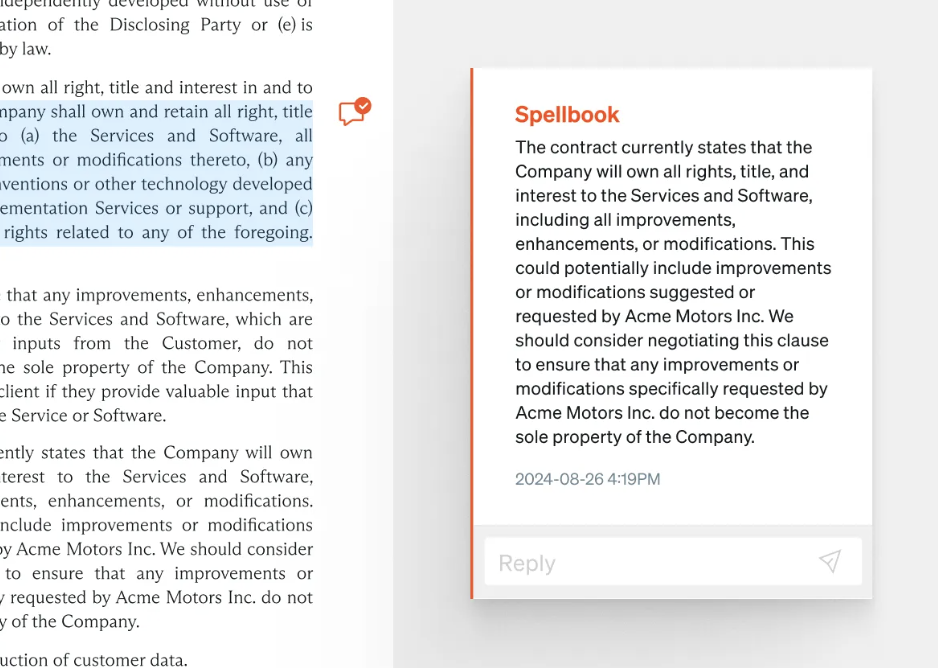
- The definition of confidential information.
- The carve-outs, and whether they are broader than the grant.
- The term, and whether the confidentiality obligation outlives it.
- The residuals clause, and the gap it can reopen in the definition.
- The return-or-destroy obligation.
The comparison pass is short because a standard position on each one is common. What the pass cannot judge is whether the carve-outs swallow the definition: a confidentiality clause with broad protection and equally broad exceptions for independently developed information protects very little, and a residuals clause can reopen the same gap by permitting use of unaided memory. The two read together, and against the return-or-destroy obligation, set how much the agreement actually protects. A non-competition provision carried inside an NDA is the second thing to look for, because it is a restraint with its own enforceability analysis rather than part of the confidentiality standard.
4. Service Agreements
Service agreement review turns on the scope description, the service levels, the remedies attached to a service level failure, change control and acceptance. Extraction gives the scope and the service levels cleanly, and it will also surface the credit formula. The judgment call is whether the remedy is worth invoking: a service credit worth a few percent of a monthly fee is a drafting artifact rather than a remedy, and the question is whether the agreement also allows termination after repeated failures. Acceptance language deserves the same read, because a deemed-acceptance clause with a short window moves the risk of an unnoticed defect onto the customer.
5. Real Estate Lease Agreements
Commercial lease review turns on the rent escalation mechanics, the operating expense definitions, renewal and holdover, and the assignment and subletting provisions. Extraction returns the escalation formula, the base year, and the expense inclusions and exclusions. The judgment call sits in the operating expense exclusions read against the base year: an exclusion that removes a cost from the base year while leaving it in the tenant's share produces an increase no clause describes as an increase. A consent standard in the assignment and subletting provisions that says nothing about reasonableness is the second item to price, because it gives the landlord a veto over the tenant's exit.
Benefits and Challenges of Using AI for Legal Document Analysis
The benefits of AI legal document analysis land on the mechanical part of review: extraction, clause comparison and first-pass risk flagging run in minutes on documents that take hours to read. The challenges land on the judgment part. The analysis can misread ambiguous drafting, it can state a conclusion the cited clause does not support, and it carries no view of the commercial relationship the document sits inside.
Benefits
- Throughput: the time saved moves to pricing the deviations instead of locating the provisions that caused them.
- Consistency: a reviewer handing off a file mid-matter inherits the same standard the first reviewer applied, not a different read of the same clause.
- Market position: a clause flagged as unusual against executed contracts is a negotiating fact rather than an assertion.
- Coverage: a provision buried in a schedule gets the same read as one in the body, where a tired reviewer stops reading first.
The gain concentrates in the mechanical part of the work, and that is the real difference between AI and manual contract review: the extraction and comparison passes compress, while the judgment time holds roughly where it was.
Challenges
- Ambiguous drafting: a provision two lawyers read differently goes to a human read with both readings stated, not into a flag as settled.
- Unsupported conclusions: a flag that names a consequence the clause does not create costs more to unwind than a flag that names no consequence at all.
- No commercial context: the term worth conceding on this deal is a question for the lawyer running the negotiation, not the pass that found it.
- Data handling: the confidentiality duty that attaches before the upload still applies to the output, not only to the document that produced it.
How Spellbook Analyzes Legal Documents
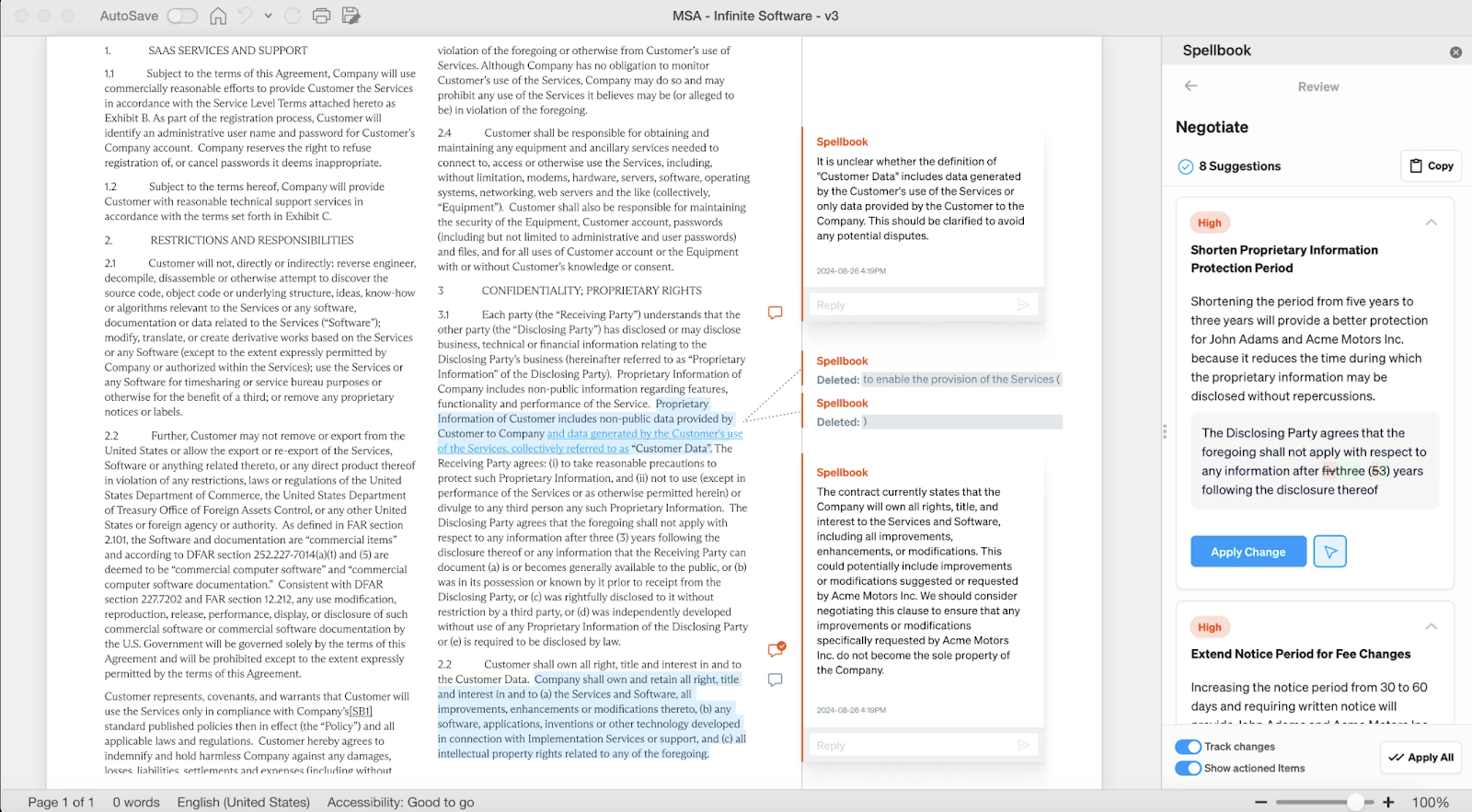
Spellbook runs AI legal document analysis inside Microsoft Word, where the Review feature reads the open document, flags the clauses that depart from the team's playbook, and proposes revisions as native tracked changes. The Compare to Market feature measures a clause against 20M+ real market contracts and 2,300+ benchmark standards, so the flag carries a market position rather than a general opinion.
What the Analysis Returns in the Document
The Review feature works on third-party paper as well as on documents the team drafted, and it returns the departures where the lawyer is already reading:
- Tracked changes a lawyer accepts, edits or rejects in the document itself, rather than a separate report to transcribe.
- A market position on the clauses the Compare to Market feature measured, drawn from executed contracts.
- The team's own positions across 270+ clause types, held in the Playbooks feature, so the comparison pass runs against a written standard instead of one reviewer's memory.
Where the Analysis Becomes a Redline
The Draft feature is where an accepted analysis becomes language, proposing replacement wording for the provisions the review flagged. The lawyer still accepts or rejects each proposal in the document.
The Error Baseline a First Pass Is Measured Against
An analysis by Spellbook Labs of 3,019 material-contract exhibits filed on EDGAR by more than 500 public companies found that 60% of SEC-filed contracts contain drafting errors, which is the reason the verification step matters on a team's own paper and not only on third-party paper. Spellbook is a commercial-contract specialist rather than a legal research platform or a contract lifecycle management (CLM) system, and 5,000+ in-house teams and law firms use it for transactional work.
Running the Analysis Across a Whole Deal
The mapping problem in M&A review, matching disclosure schedules to the representations they qualify across dozens of exhibits, is a multi-document job rather than a single-document one. The Associate feature executes multi-step instructions across every document in a project at once, and surfaces clauses or obligations across hundreds of contracts without a file-by-file review. The qualification judgment still sits with the lawyer: Associate builds the schedule index at deal volume, and the lawyer decides which disclosure actually qualifies which representation.
Try Spellbook free to run a first pass on a live document.
[cta-3]
Frequently Asked Questions About AI Legal Document Analysis
Is AI Reliable for Legal Document Analysis?
AI is reliable for extraction and comparison, and it is not reliable as the final word on what a provision means. An extraction pass that quotes the clause and cites its section can be checked in seconds, and the checking is what makes the output usable. Reliability is therefore a property of the workflow rather than of the tool.
Can AI Improve the Quality of Legal Document Review?
AI improves review quality in two ways a team can measure: coverage and consistency. The pass reads every schedule and exhibit at the same depth as the body, and it measures each clause against the same written standard for every reviewer. Quality falls where the standard is unwritten, because the analysis then reports what the document says without reporting what is wrong with it.
Are Free AI Legal Document Analysis Tools Effective?
Free tools are effective for summarizing and for first-pass extraction on a document that is not confidential. Two limits determine whether one fits legal work: many free tiers use inputs to train or refine the model, which engages the duty of confidentiality on a client document, and few of them measure a clause against a playbook or a body of market terms. A paid tier is not automatically better on either count, so both questions are worth asking.
What Does AI Extract From a Contract?
An extraction pass returns the document's factual spine:
- The parties, and the dates and notice periods.
- The defined terms, with the section where each one is defined.
- The amounts, and the operative clauses themselves with their section references.
- The clauses from the requested set that do not appear in the document at all.
The absent clause is often the more expensive finding, because nothing in the text prompts a reviewer to go looking for it.
Can AI Analyze a Scanned or Signed PDF?
A scanned or signed PDF needs optical character recognition (OCR) before any analysis runs, and the quality of that conversion sets the ceiling on everything after it. Clean scans convert well enough that extraction is dependable. Handwritten amendments, initialed changes and stamped exhibits convert poorly, so a signed copy is read against the execution version rather than analyzed on its own.
How Long Does an AI Document Analysis Take?
The extraction and comparison passes on a typical commercial agreement run in minutes. Verification is the part that takes real time, and it scales with the number of flags rather than with the length of the document: a 60-page agreement with four deviations closes out faster than a 20-page agreement with twenty.
Does AI Legal Document Analysis Replace a Lawyer's Review?
No. The analysis locates provisions and measures them against a standard, and a lawyer decides what each one means on this deal and whether it is acceptable. Every flag is checked against the source text before it reaches a redline, and the lawyer who signs the redline owns the judgment in it.
- Monthly AI spend
- ROI of legal tools
- Impact of AI






Submission Received
Thank you for your interest!

