


Gavel Exec vs Spellbook: Which Is The Top Pick in 2026?
.jpeg)


The Gavel Exec vs Spellbook decision is a common one for legal teams looking to adopt AI. While Gavel is built to systematize document creation using structured logic, Spellbook is focused on helping lawyers draft and review contracts with greater speed and precision. To help you decide, this article breaks down their core features, pricing, and technology to determine the best fit for your workflow.
Key Takeaways
- Gavel is a document automation platform that creates legal documents using structured logic and questionnaires. Spellbook is an AI suite that integrates into Microsoft Word to help lawyers draft and review contracts.
- The primary difference is their approach to legal work. Gavel focuses on systematizing document creation through rule-based workflows, while Spellbook focuses on assisting with the drafting and review of existing agreements with AI-powered analysis and market data.
- For teams focused on contract negotiation and review, Spellbook is the stronger choice. It is trusted by over 4,000 legal teams to draft and review agreements with greater speed and precision, negotiate confidently with real-time market data, and automate complex, multi-document tasks with its AI agent, Spellbook Associate.
| Gavel Exec | Spellbook | |
|---|---|---|
| Core Focus | Document automation and systematizing document production through rule-based logic and questionnaires. | Accelerating contract drafting, review, and negotiation for commercial lawyers with AI assistance and data-driven insights. |
| Primary Workflow | Uses a web application to build structured questionnaires that generate documents, alongside a Word add-in for drafting and review. | Operates entirely within Microsoft Word, allowing lawyers to review, draft, and negotiate without switching contexts. |
| Key Differentiator | Transforms legal drafting into a repeatable, logic-driven process based on predefined rules and user inputs. | Provides real-time market data to benchmark contract terms and an AI agent, Spellbook Associate, to handle multi-document workflows. |
| AI Approach | Combines structured, rule-based logic with generative AI, prioritizing institutional knowledge and templates as the primary source. | An AI-first approach that learns from user preferences and firm precedents to deliver personalized, high-quality suggestions with speed and precision. |
| Ideal User | Legal teams in document-heavy practice areas (e.g., estate planning, family law) looking to standardize and scale document creation. | Commercial law firms and in-house legal teams focused on high-volume transactional work who need to negotiate contracts faster and with more confidence. |
1. Gavel
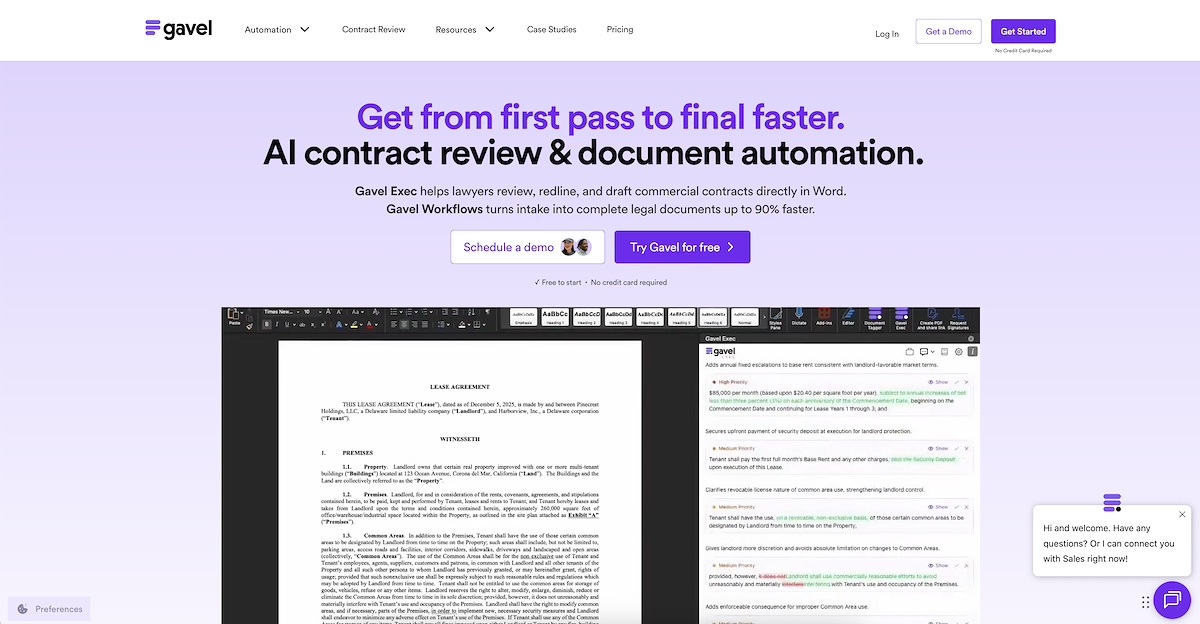
Gavel is a document automation platform that helps legal teams create documents using structured logic and rule-based workflows. It is primarily designed for practices with highly repeatable, document-heavy tasks, such as estate planning, family law, and real estate. Rather than assisting with the nuances of contract negotiation, Gavel focuses on systematizing document production from the ground up through questionnaires. This approach differs from Spellbook, which is built to help lawyers draft and review existing agreements with greater speed and precision.
Gavel Features
Gavel’s platform is built to systematize document creation through structured workflows. Its primary capabilities are centered on producing documents from the ground up, rather than analyzing existing ones.
- Document generation using questionnaires and rule-based logic.
- A Word add-in for drafting, redlining, and summarizing documents.
- Playbooks that function as rule sets to report on violations against a standard.
- A "Projects" feature for creating shared knowledge bases and clause libraries.
- A web application for designing and running structured document automation.
Gavel Pricing
Gavel offers a straightforward, subscription-based pricing model that is positioned in the lower to mid-range of the market.
- Priced at approximately $160 per user per month.
- Billed monthly with no long-term contract required by default.
- Volume discounts are available for teams of 10 or more users.
Key Considerations about Gavel
While Gavel is effective for automating the creation of high-volume, template-based documents, its focus is on production rather than the nuanced review of third-party paper. The platform is less optimized for high-stakes negotiation or complex deal review where AI-powered analysis of existing language is critical.
Its strengths lie in systematizing repeatable work, which may not fit the dynamic needs of teams that primarily redline and negotiate unique agreements. The core decision in the Gavel Exec vs Spellbook comparison often comes down to this distinction: Gavel builds documents from structured inputs, while Spellbook assists lawyers in drafting and reviewing existing contracts with greater speed and precision.
[cta-2]
2. Spellbook, The Smarter Alternative
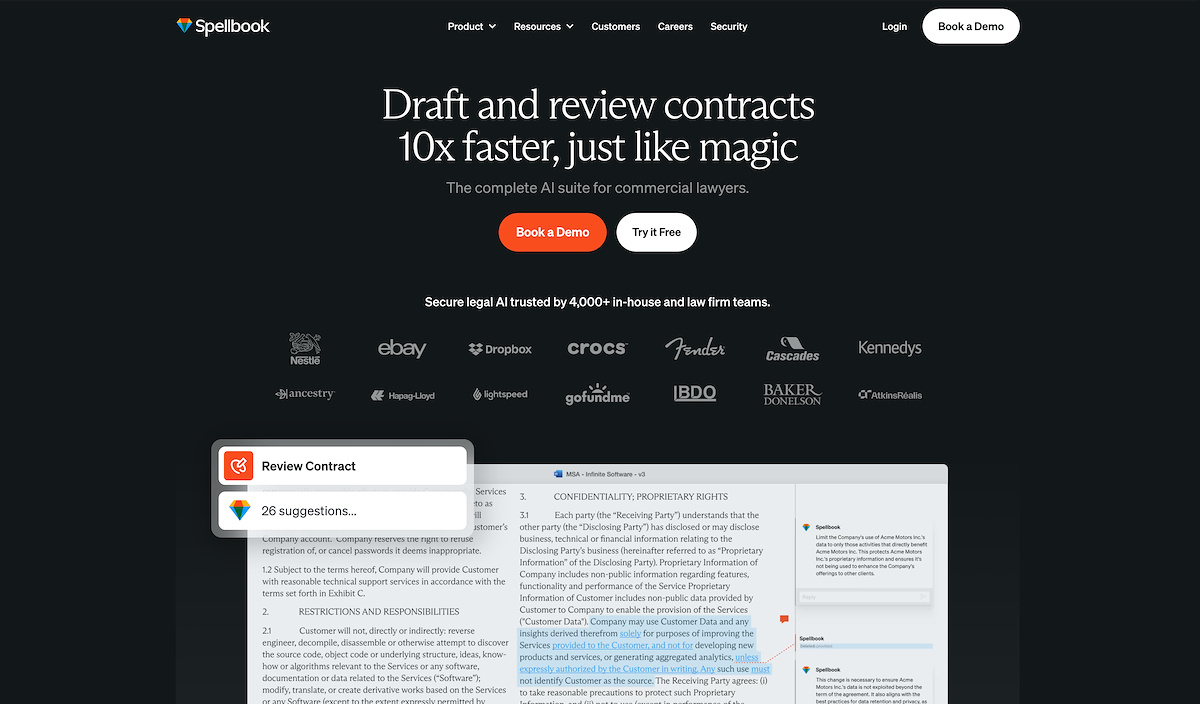
Spellbook is an AI suite built specifically for contracts and commercial law. It integrates directly into Microsoft Word, where lawyers already work, helping legal teams draft and review contracts with greater speed and precision.
Spellbook is also the only contract AI grounded in real-time market data. The Review feature analyzes contracts against live benchmarks from thousands of similar agreements, giving lawyers data-driven answers to "What's market?" in every negotiation. Today, more than 4,000 legal teams—including those at Dropbox, Fender, and Crocs—trust Spellbook to improve contract workflows.
Spellbook Features
Spellbook’s features are built for the dynamic work of contract drafting, review, and negotiation. Unlike platforms focused on document assembly, Spellbook assists lawyers directly within their existing workflows to analyze and improve agreements with speed and precision.
- Review: Instantly analyzes entire agreements to identify risks, suggest redlines, and flag missing clauses. All suggestions appear as standard track changes in Microsoft Word, keeping the lawyer in full control of the final work product.
- Draft: Generates new language, from specific clauses like indemnification to entire agreements. It can also search a firm’s past contracts to find and adapt precedent language that matches the context of the current document.
- Ask: Functions as a contract-specific Q&A tool. Lawyers can ask questions about obligations, dates, or definitions and receive instant answers with citations pointing to the relevant text in the document.
- Compare to Market: Provides data-driven answers to "What's market?" by benchmarking contract language against thousands of similar, anonymized agreements. This feature helps lawyers negotiate from a position of strength, with real-time data to support their positions.
- Spellbook Associate: An AI agent that handles complex, multi-document tasks from a single instruction. It can perform due diligence, prepare document packages from a term sheet, or update terms across multiple files at once.
Spellbook Pricing
Spellbook offers custom pricing on a per-seat, annual basis, with quotes tailored to your team's specific needs.
- Volume discounts are available for larger teams.
- All features, training, and support are included.
You can see the impact on your contract workflow firsthand. Get started with a free 7-day trial.
Why Commercial Lawyers Love Spellbook
Unlike document automation platforms, Spellbook is built for the dynamic work of contract negotiation. It excels at reviewing third-party paper and redlining complex agreements, tasks where structured, template-based systems are less effective. This focus on review and drafting is a key factor for teams weighing the Gavel Exec vs Spellbook decision.
While its deep integration is currently focused on Microsoft Word, this allows Spellbook to assist lawyers directly in their primary drafting environment. It provides data-driven negotiation points and AI-powered suggestions, giving lawyers greater speed and precision without forcing them to switch contexts.
[cta-1]
Gavel Exec vs Spellbook: Key Differences
The central difference in the Gavel Exec vs Spellbook comparison lies in their core philosophy. Gavel is a document automation platform designed to produce new documents from structured inputs. Spellbook is a contract assistance suite built to help lawyers analyze, redline, and negotiate existing agreements with greater speed and precision.
1. Core Function: Production vs. Analysis
Gavel is built to systematize document creation. It uses questionnaires and rule-based logic to generate high volumes of template-based documents, making it a strong fit for practices with highly repeatable work like estate planning or real estate.
Spellbook, in contrast, is designed for the dynamic work of contract review and negotiation. It excels at analyzing third-party paper, suggesting redlines, and identifying risks, helping lawyers navigate the complexities of unique agreements rather than just producing them.
2. Technology: Rule-Based Logic vs. Data-Driven AI
Gavel’s approach is centered on its powerful document automation engine, which follows predefined rules to assemble documents.
Spellbook is the only contract AI grounded in real-time market data. Its Review feature benchmarks contract language against thousands of similar agreements, giving lawyers data-driven answers to "What's market?" This provides a clear advantage in any negotiation, backed by statistical evidence rather than subjective experience.
3. Workflow: Document Assembly vs. In-Word Assistance
Gavel’s workflow often involves using a web application to design the automation logic before generating documents. While it has a Word add-in, the process is rooted in its separate automation builder.
Spellbook integrates directly into Microsoft Word, where lawyers already spend their time. This native environment eliminates context switching and allows legal teams to draft and review contracts with greater speed and precision, without disrupting their established processes.
4. Advanced Capabilities: Automation vs. Agentic AI
Gavel’s advanced features are focused on scaling document production through its automation engine.
Spellbook offers Spellbook Associate, an AI agent that executes complex, multi-document tasks from a single instruction. It can handle assignments like due diligence or updating terms across an entire deal room, functioning more like a delegate than a simple tool.
Which Option Is Right For Your Business?
For Firms with Repeatable Document Needs
If your practice generates a high volume of standardized documents, like in real estate or estate planning, Gavel is the logical choice. Its strength lies in automating document production from the ground up. The platform is built to turn structured questionnaires into finished documents efficiently.
For In-House Teams Managing Commercial Contracts
In-house teams that spend most of their time redlining and negotiating third-party agreements will find Spellbook to be a better fit. It works directly within Microsoft Word, avoiding workflow disruption. Its focus on analyzing existing language and providing negotiation support is critical for managing varied commercial contracts with speed and accuracy.
For Corporate Counsel Focused on M&A and Complex Deals
For lawyers navigating M&A or other complex transactions, Spellbook is the stronger option. It is designed to handle the dynamic review of unique, high-stakes agreements. The ability to quickly analyze large volumes of documents and assist with due diligence makes it invaluable when precision is paramount.
The Bottom Line
Your decision in the Gavel Exec vs Spellbook debate comes down to your primary workflow. Gavel excels at document production for practices with repeatable needs. For the majority of commercial lawyers who draft, review, and negotiate unique agreements, Spellbook offers a more direct and powerful way to work with greater precision and confidence.
Try Spellbook Free
For legal teams that draft, review, and negotiate unique agreements, Spellbook provides the critical tools for working with greater speed and precision. See how data-driven insights can strengthen your position in every negotiation by starting a free 7-day trial.
Frequently Asked Questions
Can Gavel be used for contract review, or is it only for document generation?
Gavel does offer a Word add-in and features like Playbooks that can check a document against a predefined standard. However, its primary function is document generation based on structured logic.
It is not optimized for the dynamic analysis of unique, third-party contracts. For teams that spend significant time redlining and negotiating agreements from external parties, Spellbook's AI-powered review capabilities offer a more direct and effective approach.
Which tool is better for a law firm versus an in-house legal team?
The best choice depends on the team's primary function rather than its structure. A law firm practice focused on high-volume, repeatable documents like estate plans or real estate closings would benefit from Gavel's automation.
Conversely, an in-house legal team managing a wide range of commercial agreements, or a law firm's corporate group handling M&A, would find Spellbook more aligned with their workflow. Spellbook excels at assisting with the review and negotiation of unique contracts, which is a common task for these teams.
How does Spellbook ensure the security and confidentiality of sensitive contract data?
Spellbook is designed with enterprise-grade security protocols to protect client information. All data is encrypted in transit and at rest, and the platform undergoes regular security audits to maintain its integrity.
Importantly, your contract data is never used to train public AI models. This ensures that your confidential information remains private, addressing a key concern for lawyers using AI.
How does Spellbook's AI work, and why is that a key factor in the Spellbook vs Gavel comparison?
Spellbook uses advanced large language models that are fine-tuned specifically for legal and commercial contract language. This allows it to understand context, identify risks, and suggest relevant language with a high degree of precision.
The most significant differentiator in the Spellbook vs Gavel discussion is Spellbook's use of real-time market data. The Review feature benchmarks clauses against thousands of similar, anonymized agreements, providing data-driven answers to "What's market?" for terms like a confidentiality clause. Gavel's rule-based system is built for production and cannot offer this level of analytical insight for negotiations.
[cta-2]
Our Research Methodology
This comparison is based on comprehensive research of publicly available information, including product websites, feature documentation, press releases, customer reviews, legal technology publications, and third-party analyses from sources like LawSites, Artificial Lawyer, and industry analysts.
Where pricing information is not publicly disclosed, we've included estimates based on available industry data and user reports. Information is current as of 2026 and may change as products evolve. We encourage readers to verify details directly with vendors and request demos to evaluate fit for their specific needs.
.png)
.jpg)
.png)
Get buy-in, compare platforms, and make AI stick.



Submission Received
Thank you for your interest!
.svg)
