


Demo Spellbook, get an Oura Ring 5*
See how Spellbook helps legal teams draft contracts faster than ever before.
Book Demo


Legal tech AI is software that applies machine learning, large language models, and natural language processing to legal work. In commercial practice it does five jobs: drafting contracts, reviewing contracts against a standard, running document review and e-discovery, searching case law, and extracting data from executed agreements. The technology behind each job sets how far the output can be trusted before a lawyer verifies it, and the professional-responsibility duties that govern its use are named in ABA Formal Opinion 512. Choosing between tools is a question of grounding, data handling, and what adoption actually looks like in the first month.
The economics are clearest on the commercial side of the profession. Most of the volume work that law firms and in-house teams absorb sits in third-party paper that somebody has to read, mark up, and track after signature, and contract drafting and review are where legal tech AI is used most in commercial practice.
[cta-1]
Key Takeaways
- Legal tech AI covers five tool categories: contract drafting, contract review, document review and e-discovery, legal research, and data extraction from executed agreements.
- Machine learning, large language models, and natural language processing are different technologies, and which one a tool uses sets how far its output can be relied on.
- ABA Formal Opinion 512 applies the existing duties of competence, confidentiality, client communication, supervision, and reasonable fees to generative AI use.
- The useful evaluation questions are what the model is grounded in, where the work happens, what the vendor does with the documents, and what the first month looks like.
The Technology Behind Legal Tech AI
Four technologies sit behind legal tech AI, and they are not interchangeable: machine learning, large language models, natural language processing, and the agentic layer that chains them together. Which one a tool uses explains what it can and cannot do reliably on legal work.
Machine Learning
Machine learning is a model that learns patterns from labeled examples rather than from written rules. In legal work it is reliable where the task is classification or prioritization: sorting a document population by likely relevance, flagging which of 400 agreements contain an assignment clause, routing inbound paper to the right reviewer. It is weaker on language it has not seen before, which is why a bespoke indemnity drafted by opposing counsel often comes back with low confidence. A confidence score reports how closely the text resembles the training examples. It is not a legal conclusion, and a reviewer still reads the clause.
Large Language Models
A large language model (LLM) predicts the next span of text given everything before it. That single mechanism explains both the fluent first draft and the citation that does not exist: the model produces text matching the pattern of a citation, and nothing in the mechanism checks whether the case is real. A model predicts, it does not prioritize or decide. Retrieval grounding is the usual correction, where the tool retrieves the firm's own precedent, playbook language, or primary authority and conditions the output on documents that exist. That narrows invention without removing the verification step.
Natural Language Processing
Natural language processing is the extraction layer that turns prose into fields: parties, dates, governing law, defined terms, cross-references, and the obligations that attach to each. Extraction is the least discussed of the three and the one commercial teams use most steadily, because renewal dates and notice periods are what a portfolio needs. The practitioner detail worth knowing is that unusual clause language is rarely what breaks extraction. Defined-term cross-references do, because a term defined on page 3 and used on page 70 has to be resolved before the obligation can be read correctly.
Agentic AI
Agentic AI is a model given tools and a multi-step task rather than a single prompt. Instead of answering one question, it works through a sequence: open the agreement, compare it against the playbook, draft the redlines, and summarize what it changed and why. In commercial practice today the sequences in use are narrow and bounded, and each one has a named approval point where a lawyer accepts or rejects the output before it leaves the firm. A firm deploying AI agents decides where that approval point sits.
The Five Types of Legal Tech AI Tools
| Category | What the AI does | Where a commercial practice uses it |
|---|---|---|
| Contract drafting | Generates clauses and full agreements from a precedent set | First drafts, clause insertion, playbook-conformed language |
| Contract review | Compares third-party paper against a standard and proposes redlines | Inbound nondisclosure agreements, master services agreements, vendor paper |
| Document review and e-discovery | Classifies and prioritizes large document populations | Litigation discovery, due diligence data rooms |
| Legal research | Answers questions with citations to primary authority | Memos, issue spotting, opposing-position checks |
| Data extraction | Pulls dates, parties, and obligations out of executed agreements | Renewal tracking, obligation registers, portfolio review |
Which Category Pays Off First
Which of the five categories pays off first depends on where a team's work arrives. A practice absorbing constant third-party paper gets most from contract review, because the comparison is mechanical and the volume is high: every inbound nondisclosure agreement (NDA), every master services agreement (MSA) routed from procurement, every order form attached to one. A practice with a curated set of executed agreements gets most from contract drafting, because the raw material already exists. Extraction pays off after signature, on the obligations nobody is tracking.
Categories a Commercial Team Uses Less
Legal research and document review behave differently. Both are mature categories with established vendors, and both sit outside the day-to-day of a transactional team. Document review and e-discovery is commonly priced by matter or by the volume of data hosted, while legal research is sold as a per-user subscription.
The practical filter across the hundreds of legal AI tools now on the market is which category a team's actual backlog sits in. Start from where the work piles up rather than from a feature comparison: a team whose backlog is unsigned paper is buying drafting and review, and a team whose backlog is post-signature data is buying extraction and document automation.
How AI Is Used in Legal Tech, Task by Task
AI is used in legal tech on four tasks a commercial practice performs every week: drafting from a precedent set, reviewing third-party paper against a standard, extracting data from executed agreements, and answering research questions with citations. Document review and e-discovery is the exception, for the reasons above: it is a mature, vendor-served category that sits outside a transactional team's day-to-day. The turnaround a client sees, covered last, is not a fifth task. It is the outcome the other four produce.
Drafting From a Precedent Set
Drafting with AI starts from the firm's own executed paper rather than from a generic template, and that choice decides whether the first draft is usable. A model given a precedent set produces language the firm has already negotiated and already accepts. A model given a public template produces language that has to be rewritten to match the firm's fallback positions.
The common pattern in practice is narrower: assembling a known agreement type from known clauses, then drafting the two or three provisions that are genuinely deal-specific. The time saving is in assembling the known clauses, not in drafting the deal-specific ones. Drafting goes wrong in a couple of predictable places:
- An uncurated precedent set. Several superseded versions of the same limitation of liability clause, with nothing in the file marking which one is current.
- Deal-specific clauses drafted as boilerplate. The provisions that should reflect this deal's actual terms get drafted from the precedent instead of from the deal.
Contract authoring software makes curating the precedent set the setup step rather than an afterthought.
Reviewing Third-Party Paper Against a Standard
Reviewing third-party paper is the task where AI changes the economics most clearly, because the comparison is mechanical and the volume is high. The reviewer defines the standard once, as a playbook of primary and fallback positions, and the tool compares every inbound agreement against it on three questions:
- Which clauses are missing against the standard.
- Which clauses are present but depart from the standard.
- Which departures run far enough from the standard to need a negotiation rather than a redline.
The errors worth catching are not exotic ones. Spellbook Labs examined 3,019 material-contract exhibits filed on EDGAR by more than 500 public companies and found drafting errors in 60% of them, including broken cross-references, defined terms used but never defined, and exhibits referenced but absent. Those errors are the kind a comparison pass surfaces reliably and a long manual review can miss. The practitioner step that does not disappear is the judgment call on each flagged clause, which is why review output arrives as proposed changes a lawyer accepts or rejects rather than as a finished markup.
Extracting Data From Executed Agreements
Extraction turns a signed portfolio into fields a team can query:
- Counterparty, effective date, and term.
- Renewal mechanics and the notice period that triggers them.
- Assignment and change-of-control triggers.
- Liability caps and indemnity limits.
- The obligations each party owes on a schedule.
The value of extraction is the renewal nobody tracked rather than the report itself. An auto-renewal with a 90-day notice window becomes a renewed contract the business did not intend when the only record of that window is page 14 of a PDF in somebody's folder.
What breaks extraction in practice is structure rather than vocabulary, such as a notice period expressed by reference to a defined business-day convention, or a term that depends on a schedule attached as a separate file. Metrics come from the extracted fields rather than from hand entry, and they are most useful cut by counterparty type and by business unit, because an average cycle time across a whole portfolio hides the one procurement relationship that runs far longer than the rest. Contract lifecycle management systems are where those fields usually live.
Answering Research Questions With Citations
Research tools answer a question in prose and attach citations to primary authority, and the verification duty sits on the lawyer who files the result. A tool retrieving from a licensed body of case law and linking each proposition to the reported decision is doing something different from a general model asked a legal question, and the difference is whether there is anything to check against.
What a practitioner does with the output:
- Read the cited decision rather than the summary.
- Confirm the decision supports the proposition it is cited for.
- Confirm the decision is still good law.
The failure mode worth watching for is a real case cited for a proposition it does not support, which is harder to spot than an invented case. AI legal research tools differ most in what they are permitted to search, and that permission is the first thing to ask about.
Shortening the Turnaround a Client Sees
Turnaround time is the client-visible result of the other four tasks, and it has become a commercial expectation rather than a differentiator. In Thomson Reuters' Future of Professionals study, 78% of corporate clients of professional service providers said AI-enabled quality from those providers is essential, while just 6% said their providers deliver it, and 32% say they will reconsider those relationships within 12 months.
What shortens turnaround in practice is rarely a single task getting faster. It is the first draft arriving the same day instead of the next one, the review landing before the client has to ask for it, and the status question answered from extracted data rather than by somebody opening the file.
[cta-2]
Can AI Replace Lawyers? What Legal Tech AI Does Not Do
Legal tech AI does not replace lawyers, and the gap is specific rather than philosophical: these systems cannot establish that a cited authority supports the proposition it is cited for, cannot decide what risk a client should accept, and cannot sign a filing.
Each of those is a different kind of limit:
- Verifying a citation's weight means confirming the retrieved authority actually carries the argument it is cited for, which is why a lawyer reads the decision rather than the summary.
- Deciding acceptable risk requires the client's commercial position, appetite, and history with the counterparty, none of which is in the document.
- Signing a filing is an accountability question, because a signature is a representation and a representation cannot be delegated to software.
What Professional Responsibility Requires
The duties that apply here are not new ones. Generative AI use falls under the existing obligations of competence, confidentiality, client communication, supervision, and reasonable fees, which ABA Formal Opinion 512 applies without creating a separate AI regime. What competence requires in practice is a working understanding of how a tool produces the output a lawyer then signs off on, which is a higher bar than knowing how to operate the interface. A supervising lawyer carries the same duty over AI output as over a junior associate's draft.
The cost of skipping verification is on the record. In Mata v. Avianca the court sanctioned counsel over a brief containing citations the model had invented, and the sanction turned on counsel continuing to stand behind the fabricated decisions after the court questioned them, not on the use of the tool. Firm-level governance is a separate body of work: a written use policy, client consent where the engagement calls for it, and a decision about billing for AI-assisted time are all choices a firm makes before AI for lawyers touches client work.
How to Evaluate Legal Tech AI
Evaluating legal tech AI is a question of what the model is grounded in, where the work happens, what the vendor does with the documents after processing, and what the first month of use looks like for the people who have to adopt it.
- Grounding: Is the output conditioned on the firm's own playbooks, precedents, and a body of real agreements, or on a general model answering from training data? Ask what the tool retrieves from, and what it does when it retrieves nothing relevant.
- Where the work happens: Does the lawyer work in Word and Google Docs, or in a separate application that requires exporting the document and importing it back? The second pattern is where adoption most often stalls.
- Data handling: What does the vendor do with the documents after processing, is there zero data retention, and does the contract say so? SOC 2 Type II, single sign-on (SSO), and encryption are the baseline questions, and the answers belong in writing.
- The first month: Who configures the playbook, how long does that take, and what does the team do differently on day 30 than on day 1? A tool that needs three months of configuration before it produces anything is a project rather than a purchase.
What Sits Outside These Four Questions
These four questions are about the technology and the vendor. The firm-level decisions that sit on top of them, including procurement, written policy, and how one tool gets chosen for several practice groups, are a separate exercise. Thomson Reuters' Future of Professionals study found that 66% of professionals say AI meets or exceeds expectations where a clear AI strategy is in place, compared with just 22% where there is none, which is the strongest available argument for answering the fourth question before signing anything.
Where Spellbook Fits in Legal Tech AI
Spellbook is a legal tech AI platform for commercial legal work, grounded in a firm's own playbooks and precedents plus 20M+ real market contracts, and it works in Word and Google Docs rather than in a separate system a lawyer has to open.
What the Platform Covers
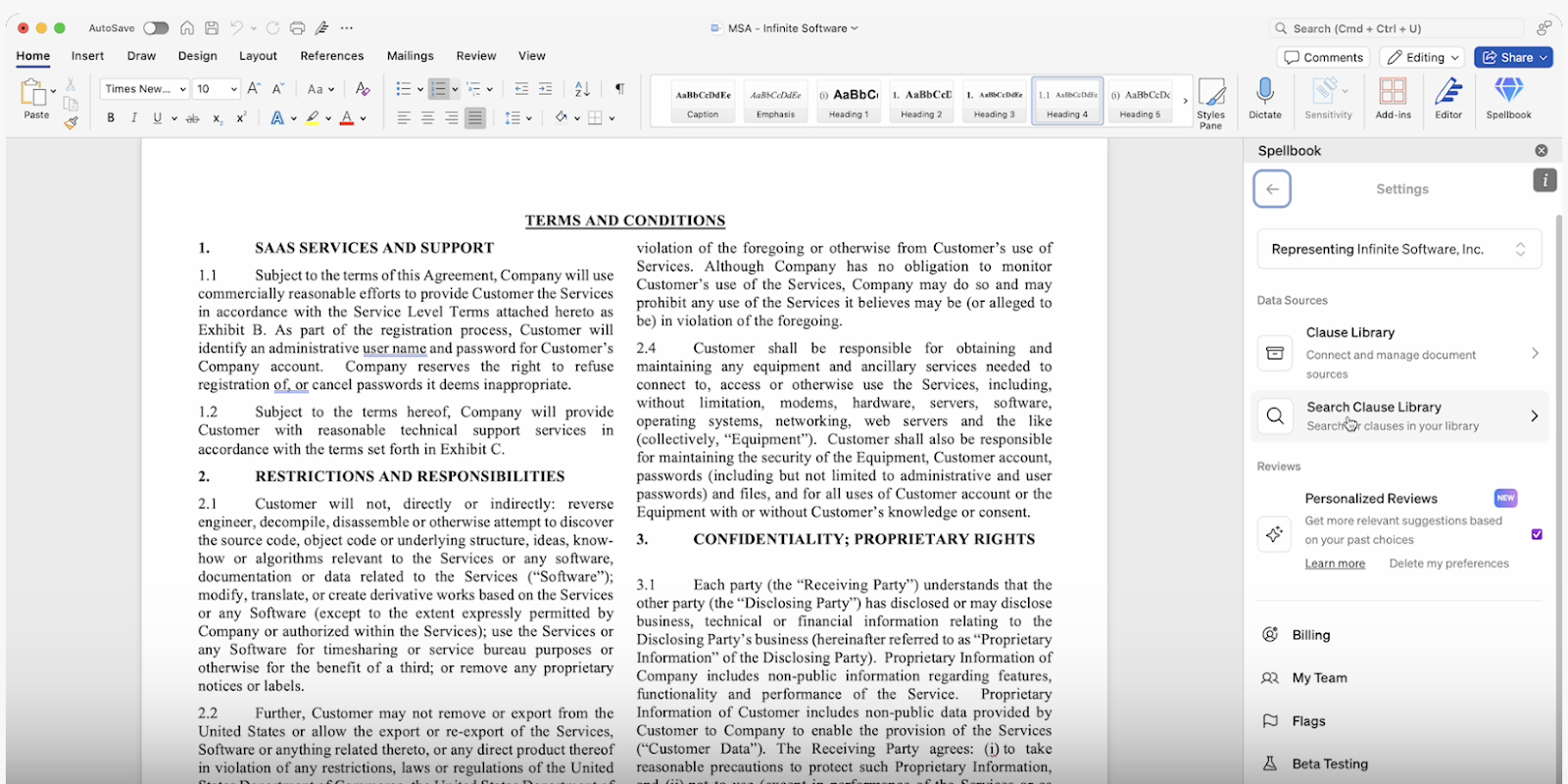
The platform covers the transactional arc rather than a single task. Spellbook's Review feature, which surfaces risks and proposes redlines as native Word tracked changes, compares inbound paper against the team's Playbooks of primary and fallback positions. Spellbook Associate handles the multi-document work, where a question spans a set of agreements rather than a single file, which is the common shape of a due-diligence request.
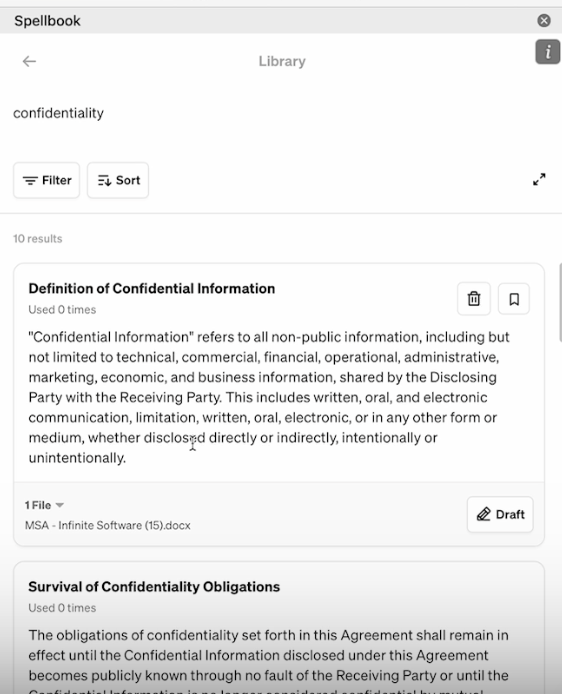
The Draft feature generates clauses and full agreements from the firm's own precedent, working from the Clause Library of 270+ clause types that a team extends with the clause language it has negotiated as positions change. The Compare to Market feature benchmarks a position against the 20M+ real market contracts rather than against a general sense of what is standard.

What Practitioners Report
Proof, where it exists, is the firm's own rather than a vendor benchmark. A partner at KMSC Law reviewed a 300-page franchise agreement by surfacing every section mentioning cost, charge, or fee along with the sections that could constitute a franchisee breach, then had the tool prompt him for the clauses he would expect to find and did not. Todd Strang, a partner at the firm, put the result this way: "It's given us a degree of efficiency we didn't have before, and we were already pretty efficient." Cyber GC reports time savings of 25-30% across review, drafting, and final cross-checks.
What Spellbook Is Not
Spellbook is a commercial-contract specialist, not a legal-research platform, not a litigation tool, and not a contract lifecycle management system, and it integrates with iManage, SharePoint, and NetDocuments rather than replacing them. A team whose primary need is case law research, or document review at discovery scale, is buying in a different category.
Data Handling and Pricing
- Data retention: zero data retention, with SOC 2 Type II, SSO, and encryption in place.
- Pricing: custom per-seat pricing by team size.
- Getting started: a free seven-day trial that does not require a sales call or an implementation project.
Try Spellbook free.
Frequently Asked Questions About AI in Legal Tech
Is AI Taking Over Law Firms?
No. AI in legal tech has changed the high-volume, comparison-heavy tasks: first-draft generation, clause-by-clause comparison against a standard, document classification, and data extraction from signed agreements. Adoption is task by task rather than wholesale. A firm that has adopted contract review has often not adopted research or e-discovery, because the categories are bought, priced, and configured separately, and each one has to earn its place against the work that firm actually takes in.
What Is Agentic AI for Law?
For legal work the distinguishing question is supervision rather than capability. An agent runs several steps without a prompt between each one, so a lawyer reviews a completed sequence instead of each intermediate answer. That changes what has to be recorded: which documents the agent opened, what it changed in each, and who approved the result before it left the firm.
Can AI Draft Litigation Documents?
Yes, for first drafts. A model can produce a motion, a pleading, or a brief in the right form and with a plausible structure, and the drafting time saved is real. The verification duty is not reduced: every citation has to be read and confirmed as good law before filing, and courts have sanctioned counsel who filed briefs containing citations that did not exist.
Are AI-Driven Legal Insights Trustworthy?
They are as trustworthy as what they are grounded in and what gets checked. Output conditioned on a defined set of real agreements or on licensed primary authority can be relied on further than output from a general model answering from training data, and the practical test is whether each assertion traces back to a document a reviewer can open.
Does Legal Tech AI Improve Contract Drafting Speed?
Yes, on first drafts of a known agreement type, where a draft that took a day to assemble from precedent can arrive the same morning. Two things do not move: negotiation length, which depends on the counterparty, and the time a reviewer spends deciding a fallback position and confirming that the precedent used is the current one.
[cta-3]
- Monthly AI spend
- ROI of legal tools
- Impact of AI






Submission Received
Thank you for your interest!

