


Spellbook vs. Callidus (StrongSuit): Key Differences for Contract Teams



Spellbook vs Callidus is a choice between a commercial contract specialist and a litigation platform. Spellbook is an AI suite for transactional legal work inside Microsoft Word, covering contract drafting, review, redlining and market benchmarking. Callidus, now operating as StrongSuit, is a litigation platform built around a proprietary database of more than 10 million United States cases, with legal research, memo drafting and document review. Both run a Microsoft Word add-in that redlines contracts, so the decision follows the work: commercial contract teams get more depth from Spellbook, and litigation groups get more from Callidus.
The two products rarely compete for the same budget line. A litigation boutique buys Callidus to shorten research and motion work, while in-house legal teams buy Spellbook to move third-party paper faster and hold one negotiation standard across every deal. The two products overlap on the Microsoft Word add-in each vendor ships, and the depth inside Word is where they separate.
Key Takeaways
- Practice area fit: Spellbook is the AI suite for transactional legal work, used by 5,000+ in-house teams and law firms, and Callidus, now operating as StrongSuit, is a litigation platform that reports 1,000+ legal organizations. Both ship a Microsoft Word add-in, which is where the two overlap.
- Grounding data: Spellbook benchmarks contract positions against market data from 20M+ real contracts, while Callidus grounds research in a proprietary database of 10M+ United States federal and state cases. Market data answers what counterparties accept; case law answers what courts have held.
- Pricing model: Callidus publishes a rate card, currently $249 per month for an individual license, with a custom quote at firm level. Spellbook sets custom per-seat pricing by team size and runs evaluations on a free seven-day trial.
Spellbook vs. Callidus (StrongSuit) Comparison at a Glance
| Dimension | Spellbook | Callidus (StrongSuit) |
|---|---|---|
| Built for | Commercial contracts: drafting, review, redlining, negotiation | Litigation: case law research, memos, briefs, discovery |
| Grounding data | Market data from 20M+ real contracts | Proprietary database of 10M+ US federal and state cases |
| Microsoft Word add-in | Review, Draft, Ask and Compare to Market inside Word | Redlining, drafting and proofreading inside Word |
| Precedent and standards | Playbooks, Clause Library, Preference Learning | Playbook upload or market standards, clause-level comparison with fallback language |
| Published pricing | Custom per-seat by team size; free seven-day trial | Currently $249 per month for an individual license; Firm by custom quote |
| Customers claimed | 5,000+ in-house teams and law firms | 1,000+ legal organizations |
| Best fit | In-house commercial teams and transactional practices | Litigation boutiques and trial practices |
Both vendors publish those customer counts themselves, so read them as vendor claims rather than audited figures.
Spellbook vs. Callidus: Features Compared
Spellbook
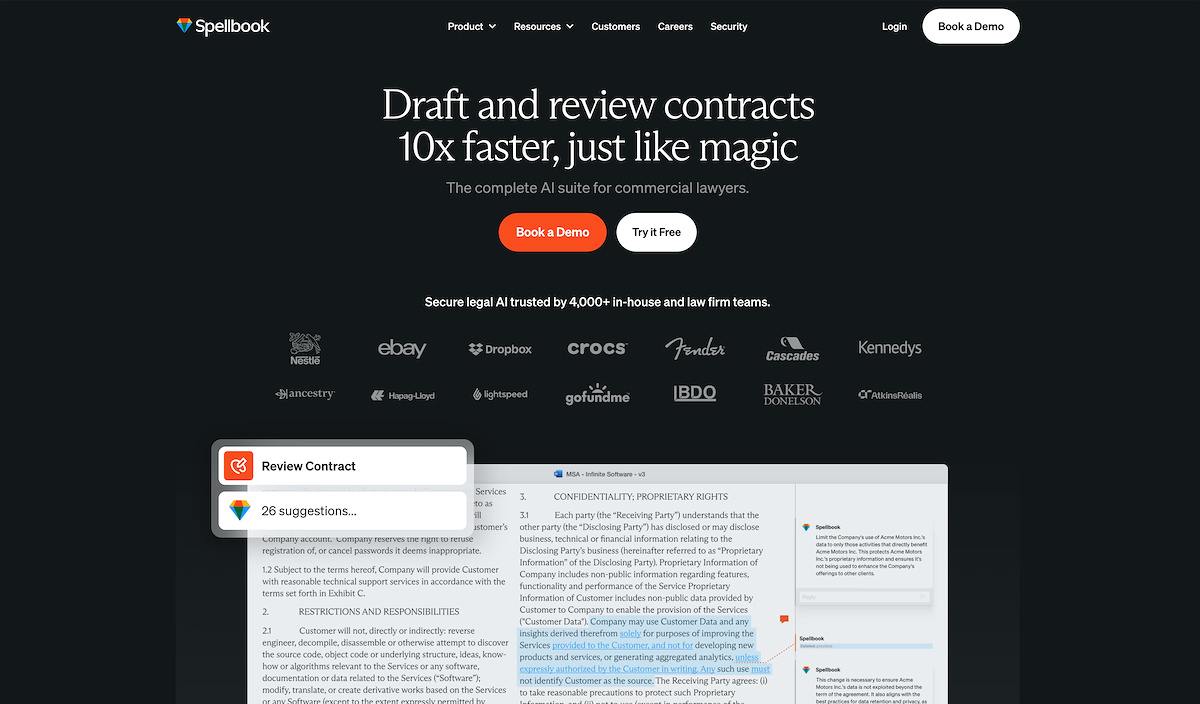
Spellbook is the AI suite for transactional legal work, and it is the specialist of the two: every feature points at commercial contracts rather than at litigation. The Review feature reads a full agreement inside Microsoft Word, generates redlines as native tracked changes and flags risk against a firm playbook. The Draft feature produces first drafts and clause language from a team’s own precedent, and the Ask feature answers questions about the document on screen without leaving the Word pane.
Benchmarking is where the two differ most in what they disclose. The Compare to Market feature checks a position, say an indemnification clause cap or a notice period, against market data drawn from 20M+ real contracts and 2,300+ benchmark standards, so a reviewer can tell a business owner whether a demand sits inside the range counterparties usually accept. Playbooks hold the standard a team has already agreed, Preference Learning carries past edits forward so the same correction is not made twice, and the Clause Library keeps approved language in one place across reviewers. For work that spans a set of agreements rather than a single document, Associate runs multi-document review across a deal folder.
Pros
- Built for commercial contract work end to end: drafting, review, redlining and benchmarking.
- Runs inside Microsoft Word, so redlines arrive as native tracked changes rather than as a summary to re-key.
- Market data from 20M+ real contracts behind a position, across 270+ clause types and 2,300+ benchmark standards.
- Playbooks and Preference Learning hold one negotiation standard across reviewers and across quarters.
- Works in Word and Google Docs, so the review happens where the document already is.
- Free seven-day trial that starts without a sales call or an implementation project.
Cons
- A commercial contract specialist rather than a legal research or litigation platform: there is no case law database, and no discovery or timeline tooling.
- No published list price, so a team cannot size a budget without a quote.
- Parts of the wider platform, including Deals, Auto Intake and Repository, are currently in development or early access rather than generally available.
- Playbook configuration is up-front work: Customer Success builds custom Playbooks in one to two weeks, so the standard a team wants enforced is not in place on day one.
Callidus (StrongSuit)
Callidus Legal AI now operates as StrongSuit, a litigation platform for firms that live in case law. The core of it is a proprietary database of more than 10 million United States federal and state cases, enriched with case summaries and issue-based tagging, feeding legal research, memo drafting, document review and timeline building. On the contract side, a Microsoft Word add-in handles redlining, drafting and proofreading, and a contract comparison module runs a clause-level comparison that benchmarks each section against an uploaded playbook or, in the vendor’s own wording, market standards, flags risky deviations and suggests fallback language. That module is the closest point of contact with the work Spellbook is built for, and it is one module among research, discovery, timelines and an oral argument simulator rather than the product’s center of gravity.
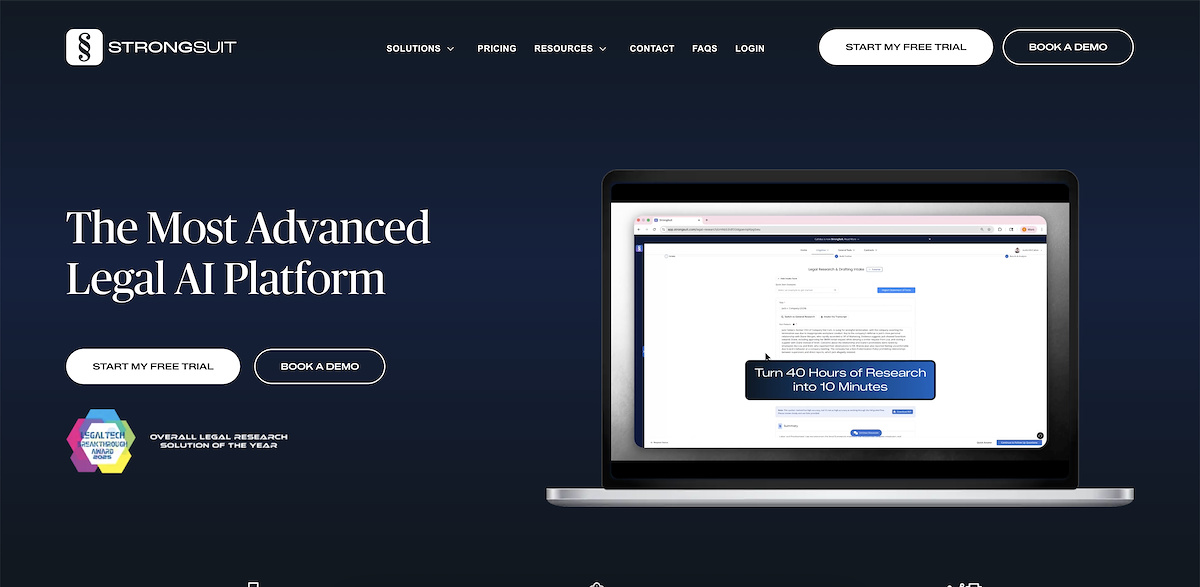
Recent funding sits behind that module list. The vendor raised $10 million in July 2025, in a round led by Cervin Ventures, and used it to enrich the case database with metadata, case summaries and issue tags. It reports 1,000+ legal organizations as customers.
Pros
- A proprietary database of 10M+ United States federal and state cases, enriched with case summaries and issue tagging.
- Litigation coverage in one platform: research, memos, document review, discovery and timelines.
- A published per-seat rate, which makes a budget straightforward to size.
- A Microsoft Word add-in that redlines, drafts and proofreads without leaving the document.
- Playbook upload behind the contract comparison module, so a firm standard can be applied to a redline.
- SOC 2 Type II, with hosting in a Microsoft Azure private tenant.
Cons
- Contract work is one module of a litigation platform rather than the center of the product.
- The vendor claims clause comparison against market standards but does not publish the dataset behind it, so the size and source of the market reference point are not disclosed.
- The accuracy and time-saving figures the vendor reports carry no published methodology, so they cannot be compared against another tool’s numbers.
- Anything above an individual seat is a custom quote, so firm-level cost is not published.
[cta-3]
Spellbook vs. Callidus: Key Differences
The key differences between Spellbook and Callidus (StrongSuit) are the practice area each one is built for, the data each grounds its answers in, and how much of the work happens inside Microsoft Word. Spellbook is a commercial contract specialist grounded in market data from more than 20 million real contracts. Callidus is a litigation platform grounded in a proprietary database of more than 10 million United States cases.
What Each Tool Is Built For
Spellbook was built around the commercial contract lifecycle: drafting from precedent, reviewing third-party paper, redlining in negotiation and benchmarking a position before a counterparty sees it. Callidus was built around litigation: finding the controlling authority, summarizing cases, drafting memos and briefs, and building timelines from discovery material. The difference is in the week each team works: a contract team’s week is counterparty paper and a negotiation standard, a litigation team’s week is research, motions and discovery, and the AI use cases each practice leans on barely overlap. Both are specialists in different practices, so a tie on Word redlining does not make them interchangeable.
The Data Behind Each Answer
Spellbook answers a market question and Callidus answers a legal question, and the grounding data reflects that. The Compare to Market feature checks a clause against market data drawn from 20M+ real contracts, so a reviewer can say whether a liability cap or an indemnity sits inside the range counterparties usually accept, a capability Spellbook set out when it introduced benchmarking contract terms against market data. Callidus runs on a proprietary database of 10M+ United States federal and state cases with issue tagging and case summaries, so a researcher can say what courts have held on a point. Neither set substitutes for the other: market data does not establish the law, and case law does not establish what the market accepts.
How Much Work Happens Inside Microsoft Word
Both products ship a Microsoft Word add-in, so working inside Word is not a point of difference between them. The depth inside Word is. Spellbook runs review, drafting, questions about the document on screen and market benchmarking in the Word pane, and returns redlines as native tracked changes. The Callidus add-in redlines, drafts and proofreads inside Word, in the vendor’s own description, while the research, discovery and timeline modules live in the web platform. For a contract team, that matters because the review, the benchmark and the redline happen in one place rather than across two.
Spellbook vs. Callidus (StrongSuit) Pricing
Spellbook and Callidus price on different models, so the two are not a like-for-like comparison. Spellbook sets custom per-seat pricing by team size and the features a team needs, publishes no list price, and runs evaluations on a free seven-day trial. Callidus publishes a rate card: currently $249 per month for an individual license, with a custom quote at firm level. The two models answer different buying questions, so the useful comparison is per-seat cost against the work each seat actually covers.
| Plan | Published price |
|---|---|
| Spellbook | Custom per-seat pricing by team size; free seven-day trial |
| Callidus (StrongSuit), Individual | Currently $249 per month for an individual license |
| Callidus (StrongSuit), Firm | Custom quote |
The individual rate is the vendor’s current published figure, and a promotional discount was running when it was checked, so confirm it before building a budget around it. On the Spellbook side, the cost of a seat moves with team size and the features a team needs, which is why the trial carries the evaluation rather than a price list.
What to Check Before You Budget
- The number of seats that genuinely need the tool, as against the number of people who will open it once a quarter.
- Whether the bulk of the work is contract volume or case research, because that decides which rate is the relevant one.
- What a firm-level quote covers: onboarding, playbook configuration and support are packaged differently by each vendor.
- Whether a promotional rate is in force, and what the rate reverts to when the promotion ends.
- How the trial maps to the work, since a seven-day evaluation only proves fit if it runs against real counterparty paper.
- Who administers the seats, and whether that is the group doing the work.
- What a second tool would cost if one product cannot cover both sides of the work.
[cta-1]
Spellbook vs. Callidus: Data Security and Confidentiality
On data security Spellbook and Callidus (StrongSuit) start from the same two commitments: SOC 2 Type II and no model training on customer documents. What each publishes beyond that differs. Spellbook lists GDPR, CCPA, PIPEDA and HIPAA compliance alongside zero data retention. Callidus publishes an Azure private tenant, encryption at rest and an optional scrub of personally identifiable information.
The Professional Duty Behind Both Tools
A published security posture answers half of the question, and professional responsibility answers the other half. Both vendors point at the same duty, which ABA Formal Opinion 512 sets out for lawyers using generative AI on client material: competence, confidentiality, communication with the client and reasonable fees. The opinion does not approve or bar any product, so the question for a buyer is what the vendor contract and the architecture commit to, specifically where documents are stored, for how long, and whether anything is used to train a model.
How to Read Each Vendor’s Confidentiality Claims
The vendor sets out the hosting and encryption posture on a page devoted to confidentiality, which also carries the claim that the platform is 100% compliant with every United States state’s ethical rules as of March 2025. That is the vendor’s own statement rather than an independent certification, and a buyer evaluating it should ask which rules were assessed and by whom. Spellbook’s zero data retention commitment is the equivalent claim to probe on the other side: ask what is retained for support or logging, and for how long.
Where General-Purpose Assistants Fit
A related question comes up before either tool is bought, because many teams started with a general-purpose assistant. Teams that have asked whether consumer chatbots keep legal documents private are usually comparing a consumer account’s data handling with a vendor contract that commits to no training and no retention, and those are different commitments with different consequences for privilege.
Questions to Ask Either Vendor Before Signing
- Where documents are stored, in which region, and under whose tenancy.
- How long material is retained after a session ends, including support logs and error reports.
- Whether any customer material reaches a model used for training, and what the signed contract says rather than what the marketing page says.
- Which subprocessors handle the data, and whether that list is published and kept current.
- What the breach notification window is, and who at the firm receives the notice.
- Whether the commitments survive renewal, since security terms are often set in an order form rather than the master agreement.
- How the vendor handles a request to delete a document, and how long deletion takes to propagate.
- What happens to stored material if the subscription lapses.
Spellbook vs. Callidus: Which Option Should You Choose?
Choosing between Spellbook and Callidus (StrongSuit) follows the share of your work that is commercial contracts. Spellbook is the stronger choice for teams whose week is third-party paper, and Callidus is the stronger choice for teams whose week is motions, discovery and case law research.
The In-House Team Living in Third-Party Paper
Spellbook fits when most of the week is counterparty paper: non-disclosure agreements (NDAs), master services agreements (MSAs), statements of work (SOWs) and order forms arriving on someone else’s template. The trigger is volume against headcount. When enough third-party paper moves through a small team that different reviewers handle the same clause in the same quarter, the problem stops being analysis and becomes consistency: a liability cap accepted at one number by one reviewer and at another number by the next. Playbooks hold the agreed standard, the Review feature returns redlines as tracked changes in Word, and the Compare to Market feature answers whether a position sits inside market range before anyone escalates it.
The Litigation Boutique or Trial Practice
Callidus (StrongSuit) fits when the week is motions, discovery and case research. The trigger is research depth: a practice that has to find the controlling authority on an issue, with case summaries and issue tagging to narrow it, gets that from a 10M+ case database and does not get it from a contract tool. Spellbook has no case law database, so a litigation group that buys a contract specialist for research work still needs a research platform alongside it. The contract add-in is then a useful second capability rather than the reason to buy.
The Full-Service Firm Doing Both
A full-service firm doing both kinds of work has a trade-off to weigh. Two tools mean two bills, two administrators and two places a document can live. One platform that is deeper on one side means the weaker side is covered rather than well served. The deciding question is which side carries the revenue and the risk. A firm whose transactional group negotiates the bulk of the client paper should buy for that group first and accept a research gap for a cycle, and a firm whose litigation group drives the billable hours should do the reverse. The questions that decide it:
- Which group’s work carries the larger share of revenue and the larger share of risk.
- Which group would lose more from the shallower tool, measured in rework rather than in seat cost.
- Whether the two groups share documents often enough that one place to keep them outweighs depth on either side.
Try Spellbook Free
The Spellbook free trial runs for seven days and starts without a sales call or an implementation project, which makes it the fastest way to test the Review and Draft features on real contracts inside Microsoft Word. Spellbook pricing is set per seat by team size and the features a team needs, so the trial is where fit gets tested before that conversation. Try Spellbook free, run it against a week of counterparty paper, and judge it on the redlines it returns.
Frequently Asked Questions About Spellbook vs. Callidus
Is Spellbook or Callidus Better for Contract Review?
For commercial contract review the two differ in depth rather than in capability. Spellbook was built for drafting, reviewing and redlining third-party paper, and benchmarks a position against market data from 20M+ real contracts. Callidus reviews and redlines contracts inside Microsoft Word and compares clauses against an uploaded playbook, with contract work sitting beside litigation research rather than at the center of the product.
Did Callidus Change Its Name?
Callidus Legal AI now operates as StrongSuit. The vendor publishes under the StrongSuit name and positions the platform for litigators, and the product, pricing and security pages are published under that name.
Can One Legal AI Tool Handle Both Contracts and Litigation?
Some platforms cover both kinds of work, but the depth usually sits on one side. A litigation platform treats contract review as a module, and a contract platform has no case law database to run research against. Where both kinds of work carry volume, one product rarely covers both at depth, and the practical test is which side of the work would suffer first from the shallower option.
Is There a ChatGPT for Lawyers?
General-purpose assistants such as ChatGPT are used by lawyers for summarizing, first-pass drafting and plain-language explanations, but they are not grounded in a verified legal source by default and they do not carry the confidentiality commitments a client file needs. Purpose-built legal tools differ in two ways: the data they are grounded in, whether that is case law or market contract data, and what the vendor commits to on retention and model training. ABA Formal Opinion 512 is the reference point for the duties either option has to meet.
[cta-2]
Our Research Methodology
Spellbook and Callidus were compared on each vendor’s published product, pricing and security pages, read directly rather than through third-party summaries, together with the July 2025 funding announcement describing the StrongSuit case law database. Spellbook’s figures come from the company’s own reported numbers. Where a vendor publishes a figure about the product, that figure is reported as the vendor’s claim rather than as an independent measurement, and negative claims about either product were checked against the vendor’s current documentation before they were made.


Get buy-in, compare platforms, and make AI stick.



Submission Received
Thank you for your interest!

