


Legora vs Harvey: Which Is The Top Pick in 2026?
.jpeg)

Legora vs Harvey is the headline rivalry in legal AI, and for good reason. These two AI-native platforms each raised more money than any other legal technology company, and they now compete directly for the same enterprise law firms. However, both of these platforms lean in different directions. Legora, built in Sweden, is strongest at structured, high-volume contract review and European jurisdictions. Harvey, built in the United States, is strongest at collaborative due diligence and US-focused legal research and workflows.
This article explores the features of each platform, their differences in focus and geography, the average costs, and the best fit use cases. Note, however, that neither platform is built specifically for the day-to-day commercial contracting work. Teams whose bottleneck is the drafting and reviewing of agreements might want to consider a contract-specific platform such as Spellbook.
Legora and Harvey at a glance
| Dimension | Legora | Harvey |
|---|---|---|
| Best for | Structured, high-volume contract review | Collaborative due diligence and large-scale document analysis |
| Core strength | Tabular data extraction across documents | Bulk analysis, agents, configurable workflows |
| Geographic depth | Europe and EU regulation | US legal and regulatory coverage |
| Scale in 2026 | About 5.55 billion dollar valuation; 800+ firms and legal teams in 50+ markets | About 11 billion dollar valuation; around 100,000 lawyers across 1,300 organizations |
| Pricing (estimated) | About 3,000 dollars per user a year, 10-seat minimum | Enterprise and custom, with higher seat minimums |
Pricing for Legora and Harvey is largely enterprise and not fully public, so the figures above are estimates. Current pricing should be confirmed with each vendor before purchase.
[cta-3]
What is Legora?

Legora is a collaborative legal AI platform for research, document review, drafting, and multi-document workflows, built in Sweden and used across more than 50 markets by firms including Linklaters, Cleary Gottlieb, and White & Case. In 2026, Legora raised a 550 million dollar Series D at a valuation of roughly 5.55 billion dollars, tripling its value in months as it expanded into the United States.
Legora’s product ecosystem - referred to as its legal AI operating system (aOS) - integrates with existing software stacks (e.g., Microsoft 365) and Document Management Systems. It is built around the core idea of a collaborative workspace model where entire matter teams and everyone, even clients, can interact with AI agents on shared documents and the same platform in real time. Legora’s core functionalities break down into four main pillars:
- Tabular Review: This feature extracts information from documents and analyses the data along given parameters. It is Legora’s signature feature and is designed for high-volume contract review, M&A due diligence, and eDiscovery.
- Legal Research: Legora combines internal firm knowledge bases (past precedents, negotiated positions, clause banks) with public legal and regulatory sources. It returns responses grounded in jurisdiction-aware research with structured citations.
- Drafting and Review: Legora can operate as a native add-in inside Microsoft Word. It has the ability to generate insertions, to suggest revisions according to firm playbooks, and to perform multi-language translations and drafting.
- AI Agents and Workflows: Sub-agents execute complex, multi-step tasks like drafting comprehensive initial summaries, running compliance checks, or comparing version changes.
Legora’s strengths lie in structured review and its focus on European law:
- Structured review: Tabular Review can extract structured data from large document sets into a spreadsheet-like view, which suits high-volume portfolio analysis.
- European depth: Covers EU regulation and the data-protection and jurisdiction-specific nuances that matter to European firms. Legora is built with strong EU data residency options and has the relevant security certifications to meet third-party diligence. Multi-language translation features make it a popular fit for cross-border European legal teams.
Legora is the stronger fit for teams doing structured, high-volume review, particularly where European jurisdictions dominate the work. Unlike platforms bound to a single AI model provider, Legora is model-agnostic. Its product backend routes different legal tasks to whichever AI model performs best for that specific use case.
What is Harvey?
Harvey is a legal AI platform built for large-scale analysis and collaborative work, aimed at large law firms and enterprise legal teams. It reached a valuation of around 11 billion dollars in 2026, and reports use by roughly 100,000 lawyers across 1,300 organizations, including about half of the 100 largest United States law firms.
Harvey focuses on enterprise-grade workflow automation, combining primary legal sources with multi-model AI routing to execute end-to-end legal workflows. The platform spans a suite of core tools designed to handle every stage of the legal lifecycle—from preliminary research to multi-document due diligence. Three features anchor the platform:
- Assistant: This is the primary, prompt-based interface for daily legal tasks, accessible via web and direct integrations into Microsoft Office and Document Management Systems. Harvey Assistant can answer natural-language legal queries, generate complex first drafts, summarize filings, and redline agreements against custom firm playbooks.
- Vault: A secure repository that can run reviews across very large document sets, supporting analysis of up to 100,000 documents. Vault can execute bulk extraction, side-by-side clause comparison, and risk tagging across thousands of pages simultaneously, exporting findings into structured reporting tables.
- Research: Harvey integrates primary legal sources (SEC filings, regulatory bodies, statutory codes, and case law databases) with a team’s internal document repositories. AI output is grounded in verified primary case law with exact page-level citations.
- Agents and Agent Builder: Dedicated AI agents that are designed to handle specific, complex workflows end-to-end (e.g., fund formation, litigation brief analysis). Legal teams can build their own agents with a no-code tool to deploy their own custom firm-specific agents to automate internal legal processes.
Harvey also offers custom training on a firm's own data, and its depth in the United States legal market makes it a strong fit for US firms running complex, multi-document diligence.
Because of Harvey’s early incubation within the OpenAI Startup Fund, the company had unprecedented access to frontier models. However, similar to Legora, Harvey now uses a multi-model selector and routes tasks dynamically between different LLM models depending on which provides the highest accuracy for a given legal task.
Where do Legora and Harvey differ?
Legora and Harvey are both AI-native platforms aimed at large firms and corporate legal departments, but three differences separate them in practice.
- Geography is the clearest one. Legora is built with depth in European jurisdictions and EU regulation, while Harvey is built around the US legal system. The right choice generally depends on which jurisdictions dominate a firm's work.
- The approach differs next. Legora leans toward structured, tabular review that turns documents into data, while Harvey leans toward configurable diligence workflows and agents that coordinate work across large document sets.
- Scale and funding are the third factor. Harvey is the larger platform by valuation and US footprint, while Legora is growing quickly from a European base and expanding into the United States. Both are well-funded enough that longevity is rarely the deciding factor.
For most firms, the practical question is not which platform is objectively better, but which one matches the geography and the shape of the work.
Where Spellbook fits for contract work
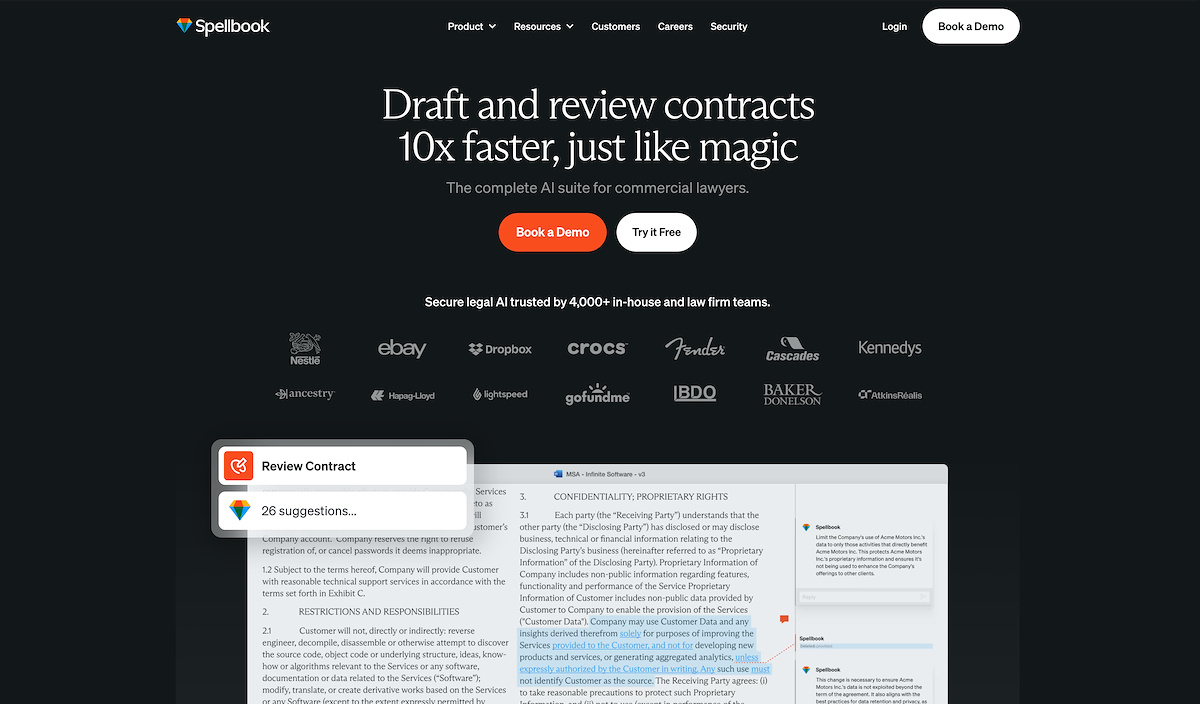
Legora and Harvey are broad legal AI platforms aimed at large-firm research, review, and diligence. Spellbook is intentionally narrower: it is an AI platform built for commercial contract work, used by more than 4,000 legal teams, and it grounds every review in a team's own playbooks and real market data drawn from 20M+ real contracts.
For a commercial team, the relevant difference is specialization:
- Review: Spellbook analyzes entire agreements and proposes redlines as tracked changes, with the lawyer approving every edit.
- Draft: It generates clauses and full agreements from a team's own precedent rather than a blank template.
- Compare to Market: This feature checks a clause against real market data from a large body of contracts, allowing a team to answer a market-standard claim with evidence rather than opinion.
- Associate agent: Runs multi-document projects from a single instruction across a set of contracts.
Spellbook does not try to be a firm-wide due diligence platform or a structured-review data tool. It is intentionally designed to address bottlenecks in commercial contracting work. Its seamless, low-friction integration directly into Microsoft Word makes it one of the easiest legal AI tools to adopt without changing daily workflows.
Spellbook Pricing
Spellbook uses a custom per-seat pricing model tailored to your team's size and needs.
- Annual subscriptions include all features, with volume discounts available for larger teams.
- Onboarding, training, and support are included with every plan.
Unlike the lengthy evaluation periods for other platforms, you can experience Spellbook's full capabilities immediately. Get started with a free 7-day trial.
Why Commercial Lawyers Love Spellbook
Unlike legal operations platforms that require users to work in a separate environment, Spellbook integrates directly into Microsoft Word. This focus makes it exceptionally fast for the day-to-day tasks of drafting, redlining, and reviewing individual agreements with high precision.
While its deep integration is exclusive to the Word environment, this allows Spellbook to assist lawyers where they already spend their time. Its ability to provide real-time market data for negotiations gives lawyers a distinct advantage. This makes it a practical tool for lawyers who need to accelerate daily contract work, rather than manage large-scale diligence projects.
[cta-1]
Which platform fits which team?
Choosing between Legora and Harvey depends primarily on geography, the scope of work, and the budget.
- Choose Legora when the work centers on structured, high-volume review and European jurisdictions, and the team wants documents turned into analyzable data.
- Choose Harvey when the priority is collaborative due diligence across large document sets in the United States legal system, with the budget for an enterprise platform.
Third option:
- Choose a contract specialist tool such as Spellbook when the core work is drafting and reviewing commercial contracts and the team wants market-grounded review rather than a broad legal platform.
Many large firms end up running more than one tool. The question to settle first is which kind of work and which jurisdiction dominates the core of the daily work.
Which Option Is Right For Your Business?
For Large-Scale Diligence Teams
Your primary need is managing complex, multi-document projects like M&A diligence. Harvey is designed for this, functioning as a project coordination platform for large teams.
It excels at organizing analysis across thousands of documents but is less focused on accelerating individual drafting tasks.
For In-House Commercial Teams
If your team spends most of its time drafting and negotiating agreements with clauses like limitation of liability, Spellbook is the most practical choice. It works within your existing Word-based workflow, increasing both speed and precision without requiring you to adopt a new platform.
Its per-seat pricing model is also more accessible for teams of varying sizes.
For Boutique and Mid-Sized Law Firms
Your focus is on delivering high-quality work efficiently. Spellbook supports this by directly improving the core tasks of contract drafting and review.
It helps you negotiate more effectively with market data and can handle complex tasks without the overhead of an enterprise system. This allows you to provide more value to clients with faster turnarounds.
The Bottom Line
Your decision in the Legora vs Harvey discussion—or whether to choose a different path—depends on your primary workflow. If you need a system to manage large-scale projects, Harvey or Legora are built for that.
If your goal is to make daily contract work faster and more accurate for every lawyer on your team, Spellbook is the smarter, more direct solution.
Try Spellbook Free
While the Legora vs Harvey debate centers on separate platforms, Spellbook improves your existing workflow directly in Microsoft Word. It provides real-time market data and high-precision suggestions to make daily contract work faster and more accurate. Start your free 7-day trial to experience the difference today.
Frequently Asked Questions
What is the difference in the AI architecture between Harvey AI vs Legora?
The core architectural difference lies in their intended function. Harvey is built on large language models, similar to technologies like GPT-4, which allows it to perform a wide range of legal reasoning, analysis, and summarization tasks across complex documents.
In contrast, Legora's AI is more focused on structured data extraction. It uses a combination of AI and rule-based systems to identify and pull specific data points from high volumes of contracts, making it more of a specialized data processing tool than a general legal reasoning engine.
How do Legora and Harvey handle data security and client confidentiality?
Both Legora and Harvey are enterprise-grade platforms designed for large law firms and corporations, so they treat data security as a top priority. They typically offer features like SOC 2 compliance, data encryption, and access controls to protect sensitive client information.
However, it is always important for legal teams to confirm the specific security protocols of any AI provider. Understanding topics like whether AI is private and where data is stored is a critical part of the due diligence process when adopting new legal technology.
Can a firm use Legora and Harvey at the same time?
Yes. Some large firms run both, using Legora for structured, high-volume review and Harvey for collaborative diligence on complex matters, since the two platforms are built around different workflows rather than competing for the same task. The tradeoff is cost and administrative overhead: licensing, training, and IT support for two enterprise platforms rather than one.
How does Spellbook fit in when you compare Legora vs. Harvey AI?
Spellbook serves a different primary purpose than the platforms in the Harvey vs Legora debate. While Harvey and Legora are legal operations platforms for managing large-scale projects, Spellbook is an AI suite built to accelerate the daily work of drafting, reviewing, and negotiating contracts directly within Microsoft Word.
Instead of requiring users to work in a separate environment, Spellbook enhances the tools lawyers already use. It focuses on improving speed and precision for individual tasks, offering unique features like real-time market data for negotiations. This makes it a more practical tool for commercial lawyers who need to improve their day-to-day contract workflow rather than manage a large-scale diligence project.
[cta-2]
Our Research Methodology
This comparison is based on comprehensive research of publicly available information, including product websites, feature documentation, press releases, customer reviews, legal technology publications, and third-party analyses from sources like LawSites, Artificial Lawyer, and industry analysts.
Where pricing information is not publicly disclosed, we've included estimates based on available industry data and user reports. Information is current as of 2026 and may change as products evolve. We encourage readers to verify details directly with vendors and request demos to evaluate fit for their specific needs.
.png)
.jpg)
.png)
Get buy-in, compare platforms, and make AI stick.

Submission Received
Thank you for your interest!
.svg)
