


GC AI vs. CoCounsel: A 2026 Comparison
.jpeg)

GC AI and CoCounsel are both legal AI platforms that review contracts inside Microsoft Word. The difference is the body of knowledge each one answers from: GC AI answers from a company's own contracts, policies, and connected systems, and CoCounsel answers from Thomson Reuters content, principally Westlaw and Practical Law. GC AI is built for corporate counsel, while CoCounsel serves law firms alongside legal departments. This comparison covers knowledge source, legal research, pricing, trials, security, and AI models, from the position of an in-house legal team choosing between the two.
Key takeaways
GC AI and CoCounsel differ in five ways worth knowing before a demo call.
- GC AI is built for in-house legal teams. GC AI reports more than 2,200 legal teams as users, and positions the product for corporate counsel rather than for firm practice.
- CoCounsel is a Thomson Reuters product. CoCounsel grounds analysis in Westlaw and Practical Law, the latter maintained by more than 650 full-time attorney-editors.
- Both platforms run legal research. GC AI searches more than 13 million United States federal and state court opinions. CoCounsel searches Westlaw primary law with KeyCite citation treatment.
- Only GC AI publishes a price. GC AI currently lists $500 per month for an individual seat with a self-serve 14-day trial. Thomson Reuters quotes CoCounsel and offers a trial of CoCounsel Essentials on request.
- Both hold recognized certifications. GC AI is currently SOC 2 Type II and SOC 3 certified. CoCounsel is SOC 2 certified and is covered by Thomson Reuters' ISO 42001 certification for AI management systems.
[cta-1]
What is GC AI?
GC AI is a legal artificial intelligence (AI) platform built for in-house legal teams, and reports use by more than 2,200 legal teams. The product connects a company's own contracts, policies, and data sources to commercial language models, so answers reflect the organization's own positions rather than generic guidance.
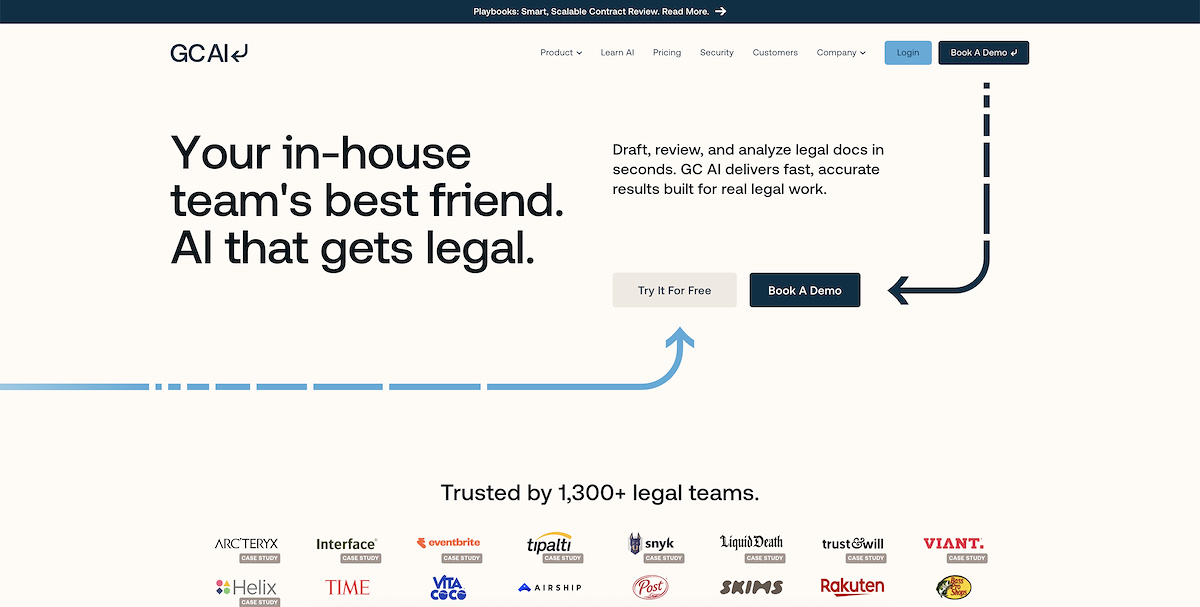
GC AI was co-founded in 2023 by Cecilia Ziniti, a three-time general counsel, and Bardia Pourvakil.
GC AI features
GC AI features run across a web application and a Word add-in that share the same company context:
- Contract work inside Word (GC AI for Word): drafting, review, and redlining on selected clauses or entire contracts
- Company-standard review (Playbooks): applies a team's own contract positions consistently across every review, running as multi-step reviews that chain several checks in one pass
- Primary-law research (Research): live search across court opinions, statutes, regulations, and agency guidance, returned as summaries, checklists, and case-law tables
- Portfolio question answering (Contract Intelligence): cited answers across an entire contract portfolio with no tagging required
- Verifiable citations (Exact Quote): citations accurate to the character, with the source document shown in view
- Reusable workflows (Skill Library): prebuilt, chainable skills for common in-house work, plus a creator for new ones
- Live context (Agent Connectors): connects email, files, calendar, and Slack so the assistant can act with a lawyer's approval
The Research feature searches a dedicated database of more than 13 million United States federal and state court opinions alongside authoritative web sources. That puts primary-law research and the organization's own contract positions behind one interface, which matters most to a lean department with no separate research subscription.
The Agent Connectors feature currently lists more than 20 connectors, covering email, file storage, calendar, messaging, and work tools such as HubSpot, Notion, and Asana, so the assistant can pull context and take actions a lawyer approves. GC AI states that more connectors are planned, so a team that depends on a specific system should confirm that connector is live before building a workflow on it.
GC AI pros and cons
The GC AI pros and cons below cover the published pricing, the research scope, and what the in-house focus leaves out.
Pros
- A published entry price and a self-serve trial: the Individual plan price and the trial length are on the pricing page, so a team can evaluate without a sales conversation
- Research and company context in one place: primary-law research sits alongside the organization's own contracts and policies
- Citations a lawyer can check: the Exact Quote feature shows the source document in view rather than asking for trust
Cons
- Only the entry tier is published: Team pricing is quoted, so budgeting past one seat needs a conversation
- Primary law is not in every seat: United States case law is included with Team and Enterprise plans and is an add-on on the Individual plan
- Scoped to in-house work: GC AI positions the product for company-focused legal work, and suggests pairing with specialist tools for firm administration, litigation discovery, approval routing, and e-signature
- A narrower research library than an established publisher: the sources are court opinions and authoritative material, rather than an editorially maintained body of practice guidance
What is CoCounsel?
CoCounsel is a legal AI platform from Thomson Reuters. The analysis is grounded in Thomson Reuters content, principally Westlaw and Practical Law, so answers carry the publisher's editorial work rather than only the customer's own documents. CoCounsel serves law firms and corporate legal departments, and is bought through a sales conversation rather than from a published rate card.
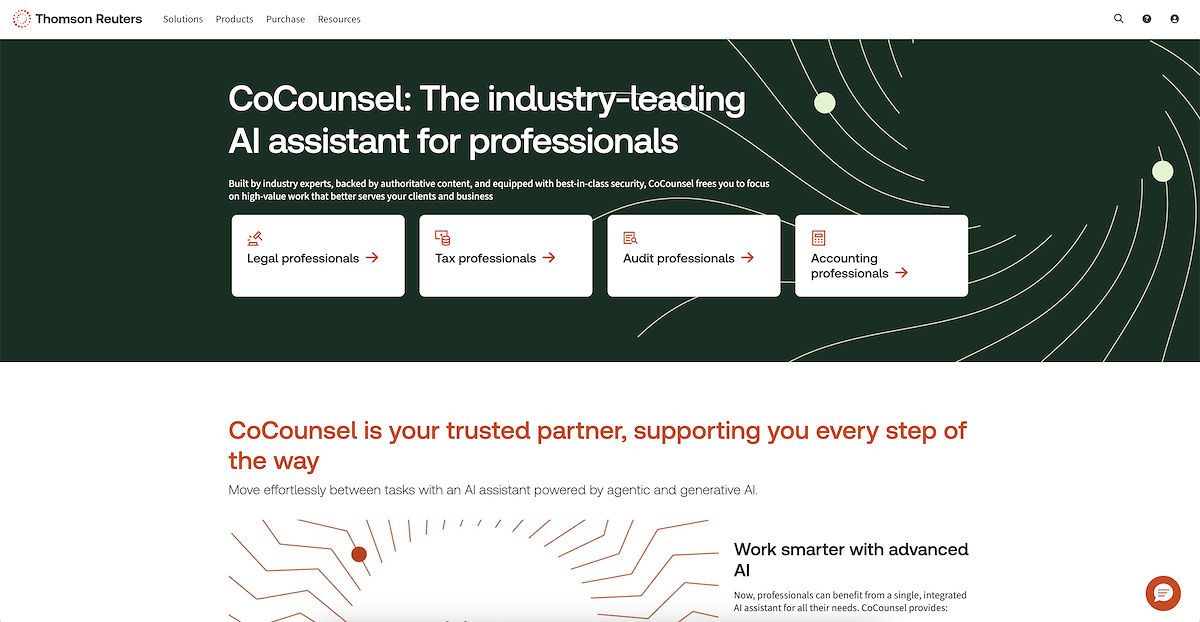
The technology arrived by acquisition. Casetext, CoCounsel's original developer, was acquired by Thomson Reuters on August 17, 2023, for $650 million in cash. The assistant is now sold inside the Thomson Reuters legal portfolio under the CoCounsel name, and the current tiers are CoCounsel Essentials and CoCounsel Legal.
CoCounsel features
CoCounsel features cover document analysis, review, drafting, legal research, and practice guidance, and they are sold in layers rather than as one bundle: an assistant tier, plus the Westlaw and Practical Law content the assistant reasons over.
- Research-grounded analysis and drafting (CoCounsel Legal): combines the assistant with Westlaw Advantage and Practical Law content on one plan
- The core assistant (CoCounsel Essentials): the document analysis, review, and drafting layer, sold without the research content
- Primary law and citation checking (Westlaw): case law and statutes, with KeyCite flagging citations whose authority has been undercut
- Practice guidance (Practical Law): practice notes, standard documents, checklists, and templates maintained by attorney-editors
- Contract work in Word: drafting, review, and refinement of documents directly inside Microsoft Word
- Use from a chat client (CoCounsel Legal MCP): listed as a current integration that drives CoCounsel Legal from inside Claude through a Model Context Protocol (MCP) connector
Practical Law states that more than 650 full-time attorney-editors keep the practice notes, standard documents, checklists, and templates current across 17 practice areas. That editorial maintenance is the part a team is paying for when it buys the content layer rather than the assistant alone.
The Westlaw layer adds primary law, and KeyCite is the component that tells a lawyer whether a cited authority still holds. For litigation and regulatory work, that citation treatment is what a team relies on when it checks whether an authority still stands.
CoCounsel pros and cons
The CoCounsel pros and cons below cover the editorial authority, the vendor consolidation, and how the content is packaged and priced.
Pros
- Editorially maintained authority: Practical Law guidance and Westlaw primary law are produced and updated by attorney-editors
- One vendor for research and AI: a team already paying for Westlaw consolidates the assistant onto the same contract
- ISO 42001 certification: an AI-specific management-system standard that some procurement teams now ask for
Cons
- Content is sold separately: the assistant is sold separately from the Westlaw and Practical Law content, so the configuration most teams want is not the entry configuration
- No self-serve trial: a trial of CoCounsel Essentials is arranged through a representative rather than started from the product
- Pricing is not published: the per-seat figure depends on which content a team activates, and the number comes from a quote
What are the main differences between GC AI and CoCounsel?
The main differences between GC AI and CoCounsel are the knowledge source, the buyer, and how each platform is bought. The table below sets out those differences dimension by dimension:
| Dimension | GC AI | CoCounsel |
|---|---|---|
| Built for | In-house legal teams | Law firms and corporate legal departments |
| Knowledge source | The company's own contracts, policies, and connected systems | Thomson Reuters content, principally Westlaw and Practical Law |
| Legal research | More than 13 million United States federal and state court opinions, plus authoritative web sources | Westlaw primary law with KeyCite, Practical Law guidance |
| Contract review | Playbooks apply the in-house team's own positions to incoming paper | Drafting and review in Word, grounded in the publisher's content |
| Word add-in | Yes | Yes |
| Published price | Yes, currently $500 per month for the Individual plan | No, configured and quoted |
| Free trial | Yes, 14 days, self-serve | Yes for CoCounsel Essentials, arranged on request |
| Certifications | SOC 2 Type II, SOC 3, General Data Protection Regulation (GDPR) compliance, AES-256 encryption | SOC 2, ISO 42001 |
| Named AI providers | OpenAI, Anthropic, Cohere | Not published on the product page |
Where the authority comes from
GC AI and CoCounsel draw on different knowledge sources. GC AI answers from the company's own executed agreements. CoCounsel answers from Thomson Reuters editorial content. A team that needs its own positions applied consistently is buying the first, and a team that needs defensible external authority is buying the second. Both platforms also run AI legal research, and the same division holds there: GC AI searches court opinions and authoritative web sources, and CoCounsel searches a publisher's primary law and maintained practice guidance.
[cta-2]
How much do GC AI and CoCounsel cost?
GC AI and CoCounsel pricing differs sharply in how each is bought: GC AI publishes a figure for the Individual plan, while Thomson Reuters quotes CoCounsel after a sales conversation, so the two cannot be compared line for line.
GC AI pricing
Our breakdown of what GC AI charges walks through the tier structure. Only the Individual plan carries a published figure. Team plans add sharing and are quoted rather than listed, and Enterprise is custom, so budgeting past one seat still needs a conversation. A Team figure has circulated in third-party write-ups, but GC AI does not publish it, so this comparison leaves it out. The Individual plan currently runs $500 per month with a 14-day free trial that needs no sales contact to start.
One line item sits outside the headline price. United States case law is included with Team and Enterprise plans and is an add-on on the Individual plan, so a solo general counsel buying at the published price should confirm whether primary-law research sits inside the seat or on top of it.
CoCounsel pricing
CoCounsel pricing is quoted rather than listed. Thomson Reuters does not publish standard pricing for CoCounsel, and estimates vary by firm size, count, and deployment scope. Which content is bundled is what moves the number: research and practice-guidance content are separate line items. CoCounsel Essentials covers the assistant, while CoCounsel Legal bundles Westlaw Advantage and Practical Law on top of it. Two intermediate plans pair the assistant with one content set rather than both, namely Westlaw Advantage with CoCounsel Essentials and Practical Law Dynamic Tool Set with CoCounsel Essentials. So the per-seat figure depends on which content a team activates, which is the detail our analysis of CoCounsel packaging works through.
Evaluation is not closed off. Thomson Reuters offers a free trial of CoCounsel Essentials, and the difference from GC AI is how it starts: a representative arranges the CoCounsel trial, while the GC AI trial begins from the product. Thomson Reuters routes teams of more than ten attorneys to a sales representative.
Questions to ask GC AI and CoCounsel before signing
- Which content is included, and which is a separate line item? For CoCounsel this is the question that moves the number most, and for GC AI it decides whether case law is in the seat
- What does the second seat cost? GC AI publishes the first seat and quotes the rest
- What happens at renewal? Content subscriptions and AI seats can escalate on different schedules
- Who owns the configuration after signature? Confirm whether and how a team can change the content mix mid-term without reopening the whole agreement
How do GC AI and CoCounsel handle security and data?
GC AI security
GC AI is currently SOC 2 Type II and SOC 3 certified and states that it complies with GDPR. Data is encrypted at rest with AES-256, a standard block cipher, and in transit over Transport Layer Security (TLS) 1.2 or later. The subprocessor list, naming the outside vendors that handle customer data on GC AI's behalf, is published.
On models, GC AI names OpenAI, Anthropic, and Cohere as the AI service providers behind the platform. It states that it does not train on customer data, that none of those three providers train on customer data either, and that it maintains zero-data-retention agreements with them wherever feasible, meaning the provider keeps no copy of a prompt once the response has been returned.
CoCounsel security
The CoCounsel product page states that the platform is currently SOC 2 and ISO 42001 certified, and Thomson Reuters has separately confirmed that CoCounsel was included in the company's ISO/IEC 42001:2023 certification for AI management systems. ISO 42001 is the item worth noting, because it certifies a management system for building and running AI specifically, rather than general information security.
Which should you choose, GC AI or CoCounsel?
The choice between GC AI and CoCounsel turns on whose knowledge should answer the question, rather than on review quality.
Choose GC AI if the answers should come from your own agreements
GC AI fits an in-house team standardizing on positions it already holds, that wants to try the product before buying and does not already pay for Westlaw. That team gets a closer fit, and a published entry price it can evaluate without a sales conversation. Teams shortlisting more broadly often also weigh GC AI alternatives at this stage.
Choose CoCounsel if you need a publisher's authority
CoCounsel fits a firm or department whose work depends on primary law and maintained practice guidance, because that team is buying the Thomson Reuters content as much as the assistant. If the team already subscribes to Westlaw, consolidating onto CoCounsel removes a second contract, a second login, and a second renewal date.
Where Spellbook fits for contract work
Spellbook is an alternative to GC AI and CoCounsel for one specific job: comparing a contract clause against the market rather than against a knowledge base. GC AI and CoCounsel both answer from knowledge that has already been written down. GC AI reads what the company agreed to before. CoCounsel reads what a publisher's editors wrote. Neither platform compares a clause against terms counterparties are currently accepting across the market.
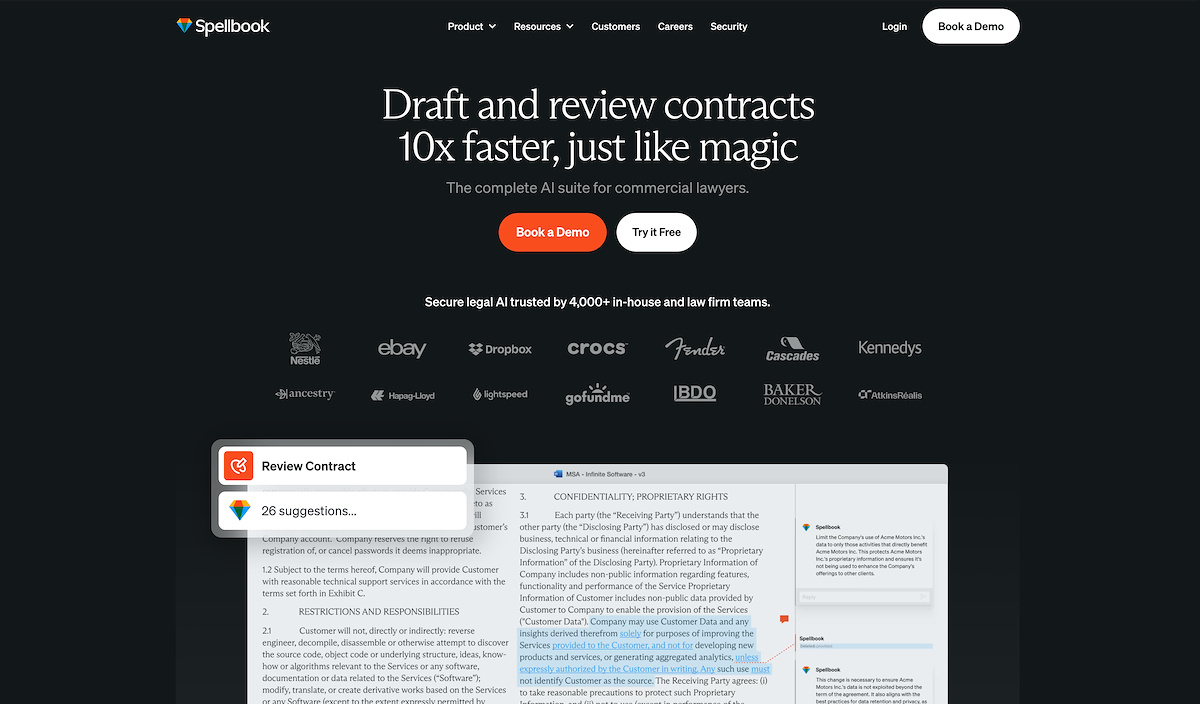
That is the gap Spellbook is built for: a team whose bottleneck is the agreement being negotiated rather than the research behind it. Spellbook is priced custom per seat by team size, with a free seven-day trial that needs no sales conversation.
What Spellbook does for contract review
Spellbook runs in Microsoft Word and Google Docs and is built around the contract from first draft through signature:
- Playbook-led review (Review): applies a team's own positions to incoming paper and returns redlines as native Track Changes for a lawyer to accept or reject
- Drafting from your own precedent (Draft): revises and generates clauses from a team's existing agreements
- Contract questions with citations (Ask): answers questions about an agreement with citations back to the clause, across more than 130 legal research sources
- Market benchmarking (Compare to Market): checks a position against more than 270 clause types drawn from more than 20 million real market contracts
- Multi-document execution (Associate): runs multi-step work across a whole document set from one instruction, returning each step for a lawyer to review and approve, and is generally available rather than in early access
How the market comparison works
The Compare to Market feature runs a clause-level comparison against that market contract set, scored against more than 2,300 defined benchmark standards, rather than asking a language model what it believes is standard. A result drawn from executed contracts can be traced back to the source agreements; a model's unsupported assertion cannot.
A maintained contract playbook helps turn a market comparison into a repeatable review, because the output still has to map to positions the team has agreed to hold.
What Spellbook is not
Spellbook is not a legal research publisher; that is the ground Westlaw and Practical Law cover through CoCounsel. It is also not a company-wide legal workspace with connectors into email, calendar, and Slack, which is part of what GC AI provides. Spellbook currently holds SOC 2 Type II, HIPAA, and GDPR compliance, and more than 5,000 in-house teams and law firms across more than 80 countries use it.
Frequently asked questions
How much does GC AI cost per month or year?
GC AI currently lists $500 per month for the Individual plan, and that is the only tier with a published figure. Annual billing is offered, but no annual price is published. Team plans add sharing and are quoted, and Enterprise is custom. A 14-day free trial is available without a sales conversation. On the Individual plan, United States case law is an add-on rather than an included component.
How much does CoCounsel cost?
Thomson Reuters does not publish standard pricing for CoCounsel, and estimates vary by firm size, count, and deployment scope. The plans differ by which content is bundled: CoCounsel Essentials covers the assistant, while CoCounsel Legal adds Westlaw Advantage and Practical Law. A free trial of CoCounsel Essentials is available on request rather than self-serve.
What AI does CoCounsel use?
Thomson Reuters does not publish a model list on the CoCounsel product page, describing the platform instead as professional-grade AI grounded in Westlaw and Practical Law content, and stating that CoCounsel is SOC 2 certified and covered by an ISO 42001 certification. CoCounsel Legal can also be driven from Claude through the CoCounsel Legal MCP connector. GC AI is more specific than Thomson Reuters on this point, and names OpenAI, Anthropic, and Cohere as the AI service providers behind the platform, stating that none of them train on customer data.
What is the best AI for in-house counsel?
The right tool depends on which body of knowledge should answer the question. A team that wants its own contract positions enforced consistently is better served by a product built for in-house legal work. A team whose work depends on primary law and maintained practice guidance is better served by a research-grounded platform. A team whose constraint is negotiating commercial agreements wants market evidence at the clause level, which is the job of a contract-benchmarking tool rather than a research platform.
Who are GC AI's main competitors?
GC AI competes with other in-house-focused legal AI products, with research-grounded platforms such as CoCounsel, and with contract specialists. Because GC AI publishes an entry price and a self-serve trial, a team can evaluate the product before any sales contact, which is not the case with a platform that is configured and quoted.
See how Spellbook handles your contracts
GC AI answers from your own agreements and CoCounsel answers from a publisher's library. If the work you need help with is the agreement on the screen, review contracts against your own positions in Word and Google Docs, and start a free seven-day trial.
[cta-3]
.png)
.jpg)
.png)
Get buy-in, compare platforms, and make AI stick.


Submission Received
Thank you for your interest!
.svg)
